Showing posts with label mystery. Show all posts

Friday, August 31, 2018

Searching (2018)


David Kim goes about his daily life, not thinking anything is wrong. He checks in with his daughter Margot to shame her for not taking out the trash and see where she's going to be, then goes to sleep like any normal day. When he wakes up, the trash is still not done and she doesn't pick up her phone all day. After some misdirections and 36 hours go by, David discovers that Margot is missing. Detective Rosemary Vick is assigned to his case and he helps the investigation by questioning all of her Facebook friends and finding out when they last saw her and their alibis. He throws himself into the work, hoping that she will be found alive.


Searching takes the Unfriended format of the computer screen as the only view and takes it into the more restrained thriller genre. The beginning is brilliant. It shows the parents' computer home screens from Windows XP and scrolls through videos, photos, emails, and calendars to show Margot being born, growing up, David's wife Pamela being diagnosed with cancer, the family bonding together and working out with her to get healthy, and her remission. When Margot is in middle school, the cancer comes back and doesn't go away. The way it's shown is in videos and photos from Pamela's hospital room and in the calendar. Her coming home date moves forward a month and then gets deleted, which was surprisingly heartwrenching. Without any narration, the story of this family is told to inform what's going on as the story moves forward.


John Cho as David Kim shows every emotion a parent would if their child was missing. He's indignant if anyone implies anything negative about Margot. He repeatedly insists that he knew her (when he clearly didn't) and tries to make amends by doing absolutely anything he can to help the investigation. He calls people, talks to them on Facetime, and even plants some cameras when he thinks he's got the perpetrator. His desperation is palpable and he clearly deteriorates as the film goes on due to sleep deprivation and emotional distress. Debra Messing is equally good as Rosemary Vick. She keeps her cool as a police officer and seems very professional in how she goes about the investigation. The only subpar acting was Rosemary's son Robert. He's supposed to have some sort of special need, but I initially thought he was just intimidated by his overbearing mom who is always whisking him out of the room or yelling at him. I assumed that was the intent, but the acting didn't really convey that.


David's journey changes drastically as more and more time passes. Everyone he interviews seems pretty unconcerned, kind of over the whole situation, and awkward. No one seems to be close to her. She eats lunch alone every day and no one seems to anything about what's going on with her. When she's officially missing and the case goes public, those same people completely change. Suddenly, everyone is praying for her and clutching their pearls when they had already heard about it. The same teens who couldn't tell her from anyone else are making videos crying crocodile tears for likes and views or making incredibly insensitive jokes about the situation. This is a fairly minor part of the story, but it rang so true to me.


The clues for the mystery are carefully plotted out. Seemingly insignificant details have greater significance later in the film or if you have an eagle eye. I caught some details early in, but I was lulled into thinking it was insignificant since it didn't come up again until the end. There are still red herrings, secret conversations, insensitive commenters online, and a variety of other misdirections. The rift with his daughter and her odd behavior really boils down to not being able to process or talk about her mother's death with the only person who would understand. David never mentions her, maybe to spare Margot from pain, but it proves to build a wall between them instead. She chooses to cope on her own, sometimes in unhealthy ways, and isolating herself from everyone in her life. Having this as the base of the film really grounded it and made the stakes mean something.


Searching is a thriller with a heartfelt squishy center. The ending surprised me, especially when there was a sort of false ending where I thought "this ending sucks!" until more information came to light. I don't feel the need to spoil it since it's not ambiguous or anything, but it's definitely satisfying without being completely fantastical. I want to see this movie again to catch the tiny details that I missed the first time.

My rating: 4.5/5 fishmuffins

Sunday, August 26, 2018

Genuine Fraud by E. Lockhart


Jule West-Williams is running from something. She affects a British accent, wears wigs, steals passports, and pays for everything with cash. Jule seems pretty comfortable staying at a Mexican resort until a woman strikes up a conversation. Suddenly, that woman (who turns out to be a cop) is following her even when she thought she was stealthy. What is she running from and who is chasing her?

Genuine Fraud is one of the most unique teen thrillers that I've read. So many fall into the same tropes (a teen having an affair with a teacher, a love triangle, a new friend to be jealous of, etc etc.) that they blend together in my mind. This one doesn't fall into any of those tropes and stands apart from those thrillers. The book is told backwards. It took a bit to get used to and figure out what was happening in what order. I spent way too long looking at the dates trying to figure out the pattern, which is that each chapter backs up one month. Once I got it, the story flowed more freely for me.

Jule is a bit of an enigma for most of the book. She imagines herself as a bad ass secret agent, but we don't know her situation until the end. Her view is completely clouded by her fantasies, making her narrative completely unreliable. My view of her changed as the novel traveled backwards in time. At the beginning of the novel, Jule seems to be some sort of heiress with unlimited funds for resorts, luxuries, disguises, and payoffs. Then the police are following her and my mind races with possibilities. Her true origin is much less glamorous. I love how the story reveals the mystery, introduces characters, and uncovers twists and turns bit by bit.

Genuine Fraud is a surprising book that seems more adult than its YA marketing. The cover makes it seem like some sort of fluffy contemporary romance. Everyone involved is college age and I think it might have been better received as an adult thriller. There's a missing heiress, her jealous boyfriend, and Jule somehow fitting into it all. As thrillers go, this one surprised me and kept me guessing all the way to the end. It's a short book that only took me a day to read and it's definitely worth your time.

My rating: 4/5 fishmuffins 

Friday, August 24, 2018

Summer of '84 (2018)


It's summer and Davey Armstrong has more time than ever to hang out with his best friends Eats, Woody, and Faraday. When they are playing "Manhunt," a tag game played at night with flashlights, Davey notices a curly haired kid in his neighbor Wayne Mackey's house only to have them disappear a moment later. He doesn't think anything of it at the time, but the next time he sees the kid's face is on a milk carton. Davey is convinced that police officer Mackey is a murderer and spends all summer snooping around and trying to prove it.


Summer of '84 is more of a mystery than a horror film that pits four teens against a possibly murderous cop who lives next door. The friends are pretty different from each other and most are fleshed out. Davey is a conspiracy theorist whose walls are papered with a paper that's essentially the Weekly World News. Eats is a wannabe punk who tries to be as abrasive as possible and has a troubled home life. Woody is the "fat kid" so common in 80's movies. He's the nicest character. Faraday is a nerd. These kids are all so different, it begs the question why they are all even friends. Faraday gets next to no character development and Eats does, but randomly leaves before the finale of the film. They do lots of typical things together like playing their "Manhunt" game, hanging out in their tree house, and looking at porn or the dressing girl next door to Davey.


Even though it has all the things that make 80's media successful, it feels a bit artificial here. The film strives to be more "adult" than Stranger Things, but comes off more offputting. Women have no major role beyond Nikki, the girl next door. Her character is completely unbelievable. First, she's the unattainable dream girl next door that Davey watches undress and then becomes something more. After she realizes this, she comes over to his house like a fantasy, pours out her heart, seems to have sexual interest in him (even though she used to babysit him), and helps with his investigation. This felt like complete wish fulfillment for Davey. Nikki is a popular seventeen year old girl. There's no reason for her to hang out with Davey when she has friends her own age beyond the artificial wish fulfullment. It's also disappointing that the writers wanted "80's authenticity," so women have no real role outside of a sex object.


Summer of '84 is overall an enjoyable movie to watch. The pacing is glacial for the majority of it and takes forever for anything to actuall confirm or deny if the cop next door is a murderer. I enjoyed the misdirections, but most of the movie was a mystery with teen antics as opposed to the horror I expected it to be. The ending is worth the wait with all the horror elements I wanted stuffed into about 20 minutes. The characters and pacing are flawed and obviously tries to capitalize on the 80's nostalgia so popular today, but it's worth a watch.

My rating: 3/5 fishmuffins

Thursday, August 16, 2018

Stalking Jack the Ripper by Kerri Maniscalco


Audrey Rose Wadsworth has a privileged life with a wealthy family. After her mother dies, a rift appears in her family as her father isolates himself. She turns to science and throws herself into studying anatomy and forensics at her uncle's laboratory against society's expectations and her father's wishes. One day, the body of a mutilated woman is delivered for her uncle to collect evidence in a disturbing case of multiple murders. Audrey throws herself into the investigation along with an annoying but brilliant rival Thomas Cresswell despite the risk of danger and irreparable damage to her reputation.

Stalking Jack the Ripper is the story of Audrey and her unconventional science education, her endeavor to solve the true crime mystery, and her first love. Some of these aspects work better than others. Audrey is a smart young woman who suffers from "not like any other girl" syndrome. She soundly rejects other women as frivolous and beneath her, which left a bad taste in my mouth. Victorian society pressures women into a certain mold that doesn't necessarily show how they are inside. This goes against her anachronistically modern view of women and their abilities. I relate to Audrey's grief about her mother's death and the negative changes she sees in her father. Her grief also led her to learning about anatomy and forensics. She takes courses dressed as a boy and stays silent even though she knows the answers. As a whole, I didn't hate Audrey, but she annoyed me.

The biggest problems I have are with Thomas Cresswell, the picking and choosing of what part of Victorian society are used, and the way the villain is treated. Thomas Cresswell is incredibly intelligent and also incredibly arrogant. His condescending nature has a misogynistic tinge to it as he mocks Audrey for not being as educated as him (because women are barred from classes). He seems to be there only to be better at everything than Audrey. I didn't find him likeable in any way and grew even more annoyed that she grew attracted to him when he's so awful. The book played lip service to some aspects of Victorian society at the beginning and then completely ignored them by the end. Audrey gallavanting around the city with Thomas and no chaperone would have destroyed her reputation. The final nail in the coffin of this book was how they treated the villain when his identity was revealed. Audrey and Thomas has the audacity to offer him resuming his normal life if he agrees to stop murdering. I felt so angry reading this because this isn't the action of a hero and it shows such privilege.

Stalking Jack the Ripper is not my favorite book. It has numerous flaws that include an annoying love interest who puts her down at every turn, inconsistencies with Victorian society (either go with it or ignore it), and an infuriating protagonist. My favorite part of the book is Audrey's view of anatomy, how she's adapted to work with the bodies, and her skill at finding clues. I also didn't guess the mystery before the end, which is rare for these teen mysteries. I am a sucker for Victorian era mysteries and this one lost me. I won't be continuing the series.

My rating: 2/5 fishmuffins

Tuesday, July 31, 2018

Friend Request by Laura Marshall


In 1989, Louise had the choice between a real friendship or a hollow friendship with acceptance to the cool crowd. She chose the cool crowd and succeeded in making Maria's life hell with cruel pranks. In 2016, Louise is a divorced single mother who works as an independent interior designer and dotes on her son. One day, she receives a friend request from Maria, who has been missing since prom night 1989 and is presumed dead. Threatening messages follow and Louise has to confront her uncomfortable past and the people from it to find out what actually happened to Maria.

Friend Request is a thriller novel about the past coming back to haunt wrongdoers. Louise is pretty insufferable and spends most of her time bemoaning her teenage mistakes and mooning over her ex-husband who replaced her with a younger woman. Right from the beginning, their relationship was creepy because she said they were everything to each other and didn't bother having any friends. The way she spoke, he seemed to tell her (maybe in not so many words) that no one would want her if they knew what she did. She keeps saying how she's changed, but then goes back to those old bad habits and clearly hasn't. Her penchant for lying to police over and over after someone died is really frustrating and does nothing at all to help her.

The novel is told in chapters from 2016 and from 1989, so we get to see first hand just how Louise was as a teenager. I fundamentally don't understand her as she oscillates for real friends and fake popular friends. It's abundantly clear that Sophie, queen bee, only wants Louise as a "friend" to do her dirty work, to make fun of, and to make herself feel better. Maria wanted to be her real friend and support each other, but then Louise would be the target of those same pranks. Maria also had rumors about her swirling around her about what happened at her old school and that she was promiscuous even though she was harassed by a stalker. Louise gets more and more entrenched in the popular crowd until she commits an unforgiveable act.

Friend Request is a frustrating book with a horrible main character. She never seemed to act in her own best interests. I kept reading to find out what the horrible act was in her past and see what other secrets would be revealed. The ending wasn't suprising. I'm surprised I read the whole book and Laura Marshall's next book has to be incredibly intriguing for me to pick it up after this one.

My rating: 1/5 fishmuffins

Friday, July 20, 2018

The Cheerleaders by Kara Thomas


Five years ago, five cheerleaders died: two in a car accident, two in a random murder, and one by suicide. The city of Sunnybrook was devastated and the cheerleading team was disbanded permanently. In the present, Monica becomes obsessed with her sister's suicide nearing the anniversary. She finds her sister's cell phone in her stepdad's desk. By itself, it isn't too suspicious, but he was also the first officer on the car accident scene and the officer who killed the supposed murderer. Is there more to these deaths than just random coincidence? Can Monica find out who killed all these girls?

The Cheerleaders is a teen thriller of a teenage girl going through a lot all at once. Monica had an abortion right before the beginning of the book and she's still cramping and bleeding afterwards. She pushes through it to try out for the dance team and is in agony. No one seems to know but her mom whose only response is that she wants Monica to learn something from it. Abortion isn't said in so many words (even though I wish it were), but it's heavily implied. I wish Thomas would have just said it if she is going to tackle the subject matter. On top of this, it's coming up to the 5th anniversary of her sister's death. Monica decides to delve into the deaths because some things just don't add up.

Monica delves into her sister Jen's life and finds out things she never knew while gathering a list of suspects. Jen's life wasn't as perfect as it seemed and she was going through a bit of a crisis. Her friends are changing, sniping at each other, and finding other interests (some of them illegal). Chapters from Jen's perspective are placed intermittently through the novel, showing what happened from her perspective. Mirroring her sister, Monica makes a new friend scorned by the school and all but abandons her own friends. As she gets more and more entrenched in this investigation, Monica gets into more and more trouble, sneaking around, lying, and hurting those around her. She can see the damage she's doing, but is still compelled to go forward. I felt for her and understood her motivation even if I disagreed with her actions.

The Cheerleaders is the best of all the thrillers I've been reading lately. The only flaw was how everything is tied up in the end. The last scene shows something that was never revealed during the rest of the book. It was an interesting reveal that told more about a character, but it was hamfistedly tacked on to the end. It's fine to have some loose ends. Real life has cold cases and unsolved mysteries all the time. Or integrate it into the story more organically. Other than that, I enjoyed the mystery and the twists and turns of the story.

My rating: 4/5 fishmuffins

Thursday, July 5, 2018

Little Monsters by Kara Thomas


Kacey is new to the small town of Broken Falls. She moved there with a family she barely knows after living with her mother and her endless stream of boyfriends, getting fed up with their explosive relationship, and running away. Now, she has two best friends in Bailey and Jade, but they want to do things like sneak out at night when she would rather enjoy being with her fairly even tempered, loving family. Then Bailey doesn't make it home after a party and no one seems to know what happened to her. Kacey dives head first into her own investigation to find out what really happened to Bailey.

Little Monsters is a teen mystery thriller centered a disappearance. Of course, rumors swirl around what happened due to the bloody discovery at a historic crime site linked to an urban legend and the sordid reputation Bailey had. Bailey was blamed for a football star Cliff drinking, driving, and losing his scholarship because she was in the car with him. Never mind that he drank and drove of his own volition and had a way more promiscuous reputation than Bailey. The whole school turned against her after that and it's completely ridiculous. It shows how if you're a football star and a guy, you can basically do no wrong in people's eyes and if you're a girl, making out with one guy means you're a degenerate slut. This difference of perception and Kacey are what set this book apart from a lot of the other teen thrillers I've been reading lately.

Kacey isn't perfect, but she tries to be. When she lived with her mom, she was prone to fits of rage, blackouts, and physical fights with her mom. Now, she has an overly goody goody facade to hide who she used to be and consistently lies to people about her past. She kept feeling that she was evil or something was wrong with her for being so violent and angry. This rang true because girls are expected to express anger in much different ways than boys and then she went to the other extreme end of the spectrum to counteract it. Even though her father is distant, she's gotten to know her stepsiblings and stepmom much better and is starting to feel like she belongs. Bailey's disappearance and her own investigation land her in trouble over and over, almost like history is repeating itself. Kacey can't just let it go when the police seem to ignore things right in front of their faces. I felt for Kacey and her need for a fresh start. I understood her feelings of self loathing and need to conform to perfection.

Little Monsters is kind of like Sharp Objects for a teen audience. The mystery is well constructed and at the end, it's shown that seemingly insignificant details were much more important. I didn't see the ending coming and it blew my mind a little when everything was revealed. The story did have some flaws. I would have liked Kacey's temper and blackouts to be established earlier. It seemed to be shoehorned in when Thomas wanted us to suspect her. I also wish she didn't lie to the police so much since it only served to muddy the investigation instead of helping in any way. Other than that, the story was enjoyable and surprisingly dark. It replicated that feeling when your gut feels like it's falling and suddenly everything you know is wrong.

My rating: 4/5 fishmuffins

Sunday, June 17, 2018

A Line in the Dark by Malinda Lo


Jess Wong and Angie Redmond are best friends, but Jess wants more from their relationship. Afraid of ruining their friendship, Jess hasn't said anything. Then Angie meets someone, a girl named Margot who steals from the cafe Angie works at while flirting with her. The situation instantly makes Jess hate Margot and creates a rift between best friends when Angie starts to date Margot. As Angie is drawn more and more into Margot's circle, Margot's best friend Ryan disappears and no one seems to know what happened.

A Line in the Dark is a dark contemporary teen novel that accurately shows the growing pains of friendship and the pain of unrequited love. Jess isn't the nicest person, but being inside her head feels authentic. She's not idealized or perfect and it's nice to see an accurate depiction of someone's inner thoughts and feelings. Jess loves Angie, but either doesn't want to ruin their friendship or is too afraid of rejection to reveal her feelings. As with any friendship that has one of the members finding first love, the relationship becomes strained when Margot and Angie date in addition to the gnawing jealousy Jess feels. Margot starts to keep secrets, dresses differently, wears more makeup, and starts to adopt Margot's mean girl tendencies. Jess starts to dig into Margot and Ryan's secrets to discredit them and get Margot back. She does turn into a bit of a stalker, following Margot and Angie around. My favorite part of Jess is her art. She draws in an anime style and has a fully realized world with ciphers for herself, Margot, and Angie to work out her feelings. It also led to some interesting revelations within her art that had a large impact on the story.

The lesbian characters are all varied and not portrayed as all evil or all good, but some sort of shade of grey in between. Angie at first seems like a genuine person, but she turns out to be extremely manipulative and pitting Jess against Margot to get what she wants. At first, we see her through Jess and her crush, so she is shown idealized, perfect in every way. Margot is a bit of a mean girl even when the Jess hate filter is taken away. She and Ryan seem to spread rumors about people and destroy their reputations for crossing them. Ryan has a secret affair with a teacher, exposed by the letter they leave for each other in the woods. I really hated how this abusive relationship was shown as totally fine and understandable. Maybe it's because it was from the point of view of high school students who see themselves as more adult, but it's not great to tell your target audience that affairs with teachers are ok.

The mystery with Ryan's disappearance makes the book take a turn. Suddenly, there are gaps in Jess's narrative and we don't know what actually happened the night of a party when Jess finds and picks up a gun and fights with Ryan. The interviews with the police are shown in transcription form and the stories Angie, Jess, and Margot tell are weirdly and similarly cagey. They all also don't seem affected at all by Ryan's disappearance when it hits rather close to home. While the mystery was interesting, the story didn't have much tension leading up to the reveal. The twists are laid out rather casually and the ending has a bizarre change from first person narration from Jess's point of view to third person omniscient. It was jarring, unnecessary, and distracted from the story. The reveal makes sense and blew my mind a little bit. It was unexpected and not at all satisfying.

A Line in the Dark shows a toxic lesbian love triangle going to extremes. While I liked the overall story, I felt that more tension could have been built. Classifying it as a thriller makes it seem like there is something missing. Maybe it was purposeful to show something about Jess, but there were quite a few runon sentences that just annoyed me. I read the book over the course of two day. I was enthralled and the pace is quick. However, the move from first to theird person felt super awkward and the reveal made me so angry. I enjoyed most of the book and I appreciate it, but I wouldn't revisit it.

My rating: 3/5 fishmuffins

Sunday, May 6, 2018

Providence by Caroline Kepnes


In a small New Hampshire town, Jon and Chloe were best friends in high school, on the way for their relationship to become something more. Then, Jon was kidnapped by a substitute teacher when he was taking a shortcut through the woods to school. Chloe is frantic and eventually rebels when no one seems to care. Eventually, she returns to her popular friends and acts like everything is normal. Four years later, Jon wakes up in a mall basement with no memory at all of the time elapsed. He finds that he somehow hurts people by being near them and runs away until he can get a handle on the power after he kills someone. Chloe goes on to be a successful artist and a detective named Eggs starts to follow mysterious heart attack deaths with interest. Will Jon ever have a normal life or will his crimes catch up with him before that can happen?

Providence is a  much different book than Kepnes' previous two book, You and Hidden Bodies. Some fans of those books are going to be disappointed with a Lovecraftian, supernatural story. However, the mutual obsession between Jon and Chloe brings in that intense point of view that she did so well. I love supernatural books, so this wasn't an issue for me. The plot has a lot of positive elements. I can't help but feel for Jon, abused by others as a child, kidnapped, robbed of four years of his life, and saddled with toxic powers to those around him. The Lovecraftian elements are well done and friendly to those not familiar with his work. Passages from The Dunwich Horror are provided for context and integrated into the story as Jon's obsession because it was the only thing left by his captor. His actual powers are mysterious for much of the book, but make sense and something I haven't seen before. I also enjoyed how unhinged Jon became nearing the end of the book.

Unfortunately, I had numerous problems with the book as well. First, the book plods along and my interest phased in and out as it went. Second, Chloe is always defined by Jon and never really moves on unless it's to a toxic ex from high school. She never seems to know how to survive alone or find someone completely outside of her hometown and her trauma. It was incredibly frustrating to witness because of her potential and talent for art. Third, the way Chloe treated Jon when they were teens was pretty awful. She would hang out with him and treat him nice alone and then act like she didn't know him in front of popular people. She would never call anyone out for teasing or bullying him and seemed to just be using him. Fourth, so much would have been solved with a simple phone call, text, or email from Jon to Chloe.

Providence is an interesting novel that combines Lovecraftian horror with a mystery thriller. It's a bit out of the box for Kepnes and I enjoyed it about as much as her You series. Even though I have mixed feelings about most of her books, I enjoy the unique ideas she brings to her novels. I would still be curious to read whatever new releases she comes out with, particularly if it has a more fantasy or horror angle.

My rating: 4/5 fishmuffins

Wednesday, April 4, 2018

Book Mini-Reviews: The Unfleshed: Tale of the Autopsic Bride by Lisa Vasquez and Ash Princess by Laura Sebastian

* The Unfleshed: Tale of the Autopsic Bride by Lisa Vasquez


Angus is a sadistic but successful doctor completely obsessed with a wealthy woman named Morrigan. The Black Death spreads rapidly across Europe and threatens his love and his city as a whole. The Unfleshed is a novel that feels scattered and confused. I didn't know until late the book what era it was in and so much basic information about the time is wrong. Plague doctors were not trained doctors and were not effectual. The reigning theory was miasmatism that saw bad air as the cause of ailments. This wasn't even mentioned until very late in the book, which is weird since much of the novel is from the point of view of the doctor.

The main characters is Angus and all the other characters are flat and undeveloped compared to him. His driving force is to possess Morrigan and do all sorts of depraved things to her. I expected it to be more focused on Morrigan, the title character, who is not in the majority of the novel. She becomes a kind of Bride of Frankenstein amalgamation of other women because of Angus and barely makes a blip in the novel. Instead, Angus' history is delved into and his present as he tries to find a cure for death. He isn't the type of villain that can carry a novel because he's terribly unsympathetic and there are no redeeming qualities to him at all. I thought this would be much more of a horror novel overall and I was pretty disappointed.

My rating: 1.5/5 fishmuffins

* Ash Princess by Laura Sebastian


Theodosia's whole life changed when she was only 6. Her kingdom was invaded and taken over by conquerors who destroyed her people, her family, and her culture. The new regime keeps her around to abuse her when her people rebel and to publicly remind anyone what happens when they are opposed.

The premise to Ash Princess is intriguing, but the reality fell flat for me. I didn't finish this book. I only read about 50 pages and realized I had no emotional investment in anything. The writing and language left me feeling detached. Her name is ridiculoous and her thought process is defining her every emotion and motivation, which makes for repetitive, dry reading. The magic system of her people is very typical and the word "spiritgems" just makes me cringe. All of the background information is dumped in the narrative without integrating it into the story and it takes a while.

The point that I put down the novel was when the evil king forces Theo to kill a rebel who turns out to be her own father. This passage held no emotional impact for me. It's too early and not enough is known about the main character for this to occur so soon. Also, the plot in general feels too close to Children of Blood and Bone by Tomi Adeyemi, which is already one of my favorite books of the year. Ash Princess simply pales in comparison in terms of prose and world building. They share many of the same themes and it's unfortunate that they are coming out so close together. Ash Princess wasn't for me.

My rating: 2/5 fishmuffins

Wednesday, March 21, 2018

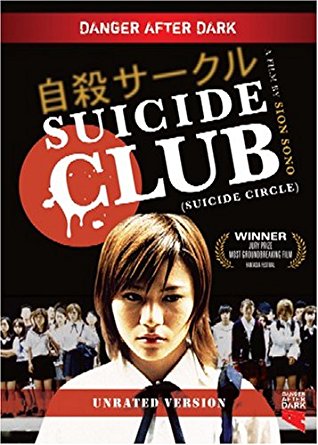
Suicide Club (2002)


Fifty four school girls held hands and jumped in front of a train in Tokyo, drenching everything around with blood and gore and shocking all of Japan. Shortly after, two nurses jump out of a hospital window to their deaths with absolutely no warning. As the amount suicides climb, the police investigate the baffling case. The only clue tying the incidences together is a coil made of strips of human skin, only a few belonging to the dead. What is causing people to kill themselves?


Suicide Club has a shocking, bizarre premise with many different threads making the whole story that occurs over only six days. The police are investigating the suicides headed by Detective Kuroda. Right at the beginning, Kuroda seems like the main protagonist, a seasoned cop working as hard as he can to solve the case. His family is normal with loving moments, bickering, and sullen teens. He doesn't turn out to be the main character. Mitsuko, a young woman almost killed by her boyfriend's suicide fall, plays a much more significant role when she finds clues in her boyfriend's apartment. I love this misdirection because Mitsuko doesn't have expertise and accomplishes more than the entire police force. It also derails the film from its police procedural formula to something else.


The most striking scenes of the film are the suicide scenes. The vast majority of them are done by fairly cheerful people or accompanied by the music of Dessert, a fictional children's pop group. Their music is vapid, cheerful, and people of all ages enjoy it. From the very first blood soaked train scene to a housewife smiling while chopping off her own fingers, these grisly scenes are burned into my brain because of the chilling duality and how each situation varies from the next. Other memorable scenes are obliquely related to the plot such as the glam rock gang headed by Genesis that wants to accept blame for the Suicide Circle. They end up being an odd, musical red herring.


Although Suicide Club is a different film that doesn't follow genre tropes, it's a bit of a mess. The film seems to be pointing to pop music or the internet as sources for the mysterious rash of suicides. However, the ending has more style over substance. There are no real answers which I don't mind, but the bigger questions being asked don't really resonate. It seems to be weird for the sake of being weird rather than connecting to the story. Also, all of the small threads felt more like a series of vignettes in the same world rather than a cohesive story. Overall, Suicide Club is a memorable film that started my love and interest in Japanese horror films. It's definitely dated and has flaws. However, the innovation in plot, misdirections, and cast of characters make me love it still.

My rating: 4/5 fishmuffins

Saturday, February 24, 2018

Women in Horror: Reign of the Fallen by Sarah Glenn Marsh


Odessa is known as The Sparrow, a powerful necromancer with the ability to adeptly navigate the Deadlands. She and Evander, her boyfriend, are finally full fledged master necromancers that service the crown and the wealthy members of society who want their loved ones brought back from the dead. The same day they killed and resurrected King Wylding, her mentor Nicanor went into the Deadlands by himself, an oddity for a necromancer, and was killed by a Shade, a spirit of the dead made into a cannibal monster. They have to resurrect the King no matter what, even if a dangerous Shade stalks them. The Shade problem isn't restricted to the Deadlands. Royalty and the rich have been disappearing at alarming rates, some turning up as Shades and others gone. Odessa and the other necromancers must band together to solve the mystery before the Shades endanger the enture population.

Reign of the Fallen has a unique world and vibrant characters with realistic thoughts and decisions. Karthia has been ruled by King Wylding for over 200 years and nothing has changed. It's argued that he knows and loves Karthia more than anyone else. There have been no advancement or changes in technology, fashion, policy, or tradition ever. Even if something would improve things, it's soundly ignored due to the deeply held tradition of stagnanace. Vaia, goddess of change, has been completely removed from their pantheon of gods. It felt a little similar to the society in Mistborn, but less toxic. Most people here accept it as law and only the young and powerful subvert in small ways, hidden from public.

The big contributor to the tradition is the continued existence of people, even after they die. Ancestors from generations past can still live among their descendents and affect their decisions. They can't be seen directly and where full body shrouds because they turn to Shades if humans see them. They can also turn if left in a body for so long, hence why Wylding has to be killed and resurrected every so often. So far, this has never been a problem, but Shades are rampaging more and more along with the missing wealthy people. Necromancers go into the Deadlands with honey to reject the food of the afterlife, blood to attract the dead, and milk to pour on the dead's body. Their power is steeped in myths and legends, but also feels different than other renditions.

The magic system makes sense to me and has wide ranging capabilities. In addition to power over the dead, others have the power to heal or power over animals. All magic has a price. Necromancers can't be brought back from the dead and non-mages who go into the Deadlands are no longer fertile. Healing magic leads to temporary numbness and paralysis of the healer's body depending. Power to control animals leads to the mage being animalistic for a time, losing their humanity. All of this is equal to the power they used. I'm a little tired of magic that just appears out of nowhere with no limits instead of having some sort of natural balance.

The characters feel like real people. Odessa has confidence and power, but started out as an orphan who had nothing as a child and was raised by necromancers to be one. Without her power over the dead, she sees herself as only an orphan with nothing to offer, which starts fights with wealthy Evander when he wants to run away from his problems. Beyond this idiocy, her relationship with Evander is sweet and healthy beyond hiding it from his unsupportive mother. After he dies, she starts a self destructive path that starts with the overuse of sedatives and ends at beating the Shade who killed her loved one, probably dying right afterwards. Through her friendships, particularly with princess Valoria and Evander's sister Meredy, Odessa gets to a place where she feels the grief, returns to reality, and moves forward.

The relationships are particularly excellent, especially between women. Valoria started out as unsure of herself and content to hide in the shadows. She built inventions that she hid in her room so the king and court would never see it. Odessa helped her find her voice and see that her opinion has value, which becomes extremely important by the end of the story. Odessa and Meredy at first hate each other and are too wrapped up in their own loss to see how lashing out hurts the other. Over time, they get to know each other and bond over their grief for Evander when open and honest about it. Eventually, they feel romantic feelings for each other that they feel guilt for. It's refreshing to see a bisexual heroine in any media, but I question the choice of Evander's sister. Other than that, it's a very sweet romance.

Reign of the Fallen has wonderful world building, well drawn characters, and action packed scenes right next to quiet, emotional ones. I loved that it has elements of fantasy, horror, and mystery with realistic relationships and grounded people. I figured out the mystery early, which is a big deal for me, but I enjoyed going along on the ride. The ending still surprised me mostly because the villain wasn't really wrong, but the way he went about things was. I would love to read more books by this author and hopefully in this world.

My rating: 5/5 fishmuffins

Monday, December 4, 2017

Bonfire


Abby Williams returns home for the first time since she left a decade ago to investigate a large company. Traumatic events haunt her there  from the cruel teasing of a high school clique to her father’s anger. Returning makes these suppressed feelings and memories rise to the surface. As her investigation deepens, it seems to be inextricably tied to her past. Her actions get more desperate and erratic, calling into question if she’s simply traumatized by the past and having a mental break or if the company is really the cause of the trouble of her teenage years.

Bonfire drew me in with the concept of a small town with secrets and kept me glued to the book with the characters, the writing, and how deep those secrets go. Abby Williams went from high school outcast to environmental lawyer. As a teen, she was tormented by a clique of popular girls who went so far as to make fun of her mothers' death and her own suicide attempt. They made public polls about her and offered to help her with her next suicide attempt. As an adult, the town hasn’t physically changed much and the same people live there. She's the one who has changed, gaining fame for actually leaving and building a new life for herself. While people tend to speak highly of her, the company she's investigating pretty much owns the town, leading the townspeople to mistrust her and make their allegiances clear.

The mystery had some predictable elements and other surprising turns. History is repeating itself. A tactic to humiliate teenage girls in the past was to get them drunk, take compromising pictures of them, and circulate them around school. The present holds the same, but is there a more insidious reason? Why would this practice be exactly the same after so many years? Abby finds out much more about her main tormentor, Kaycee. In the past, Kaycee and her friends came down with a mysterious sickness that proved to be fake in all but Kaycee, who is conspicuously absent in the present. Abby delves into the past and discovers that there was more to Kaycee than she ever expected. As she gets closer and closer to the truth, Abby starts to break down, drinking too much, sleeping to little, exhibitng erratic behavior, and bending or breaking laws to get information, calling into question her capability of completing her investigation.

When I picked up Bonfire, I expected a fairly generic book. Krysten Ritter weaves a compelling story with a flawed protagonist who can't truly move on with her life due to her unresolved pat. Although I didn't agree with everything Abby did, I understood and related to her overall reasoning. I hope Krysten Ritter writes more books after this. I would recommend this to fans of Gillian Flynn and other twisty mysteries.

My rating: 4.5/5 fishmuffins

Friday, August 25, 2017

Book Mini-Reviews: A Good Idea and A Poison Dark and Drowning

* A Good Idea


Finley moved away from her best friend Betty in a small town in Maine to go to college in Manhattan, but their friendship stayed intact. They called, texted, and visited during the summer to keep ties. Then Betty goes missing, presumed by most to have committed suicide. Her ex-boyfriend Calder admitted to drowning her, but the confession is thrown out as coercion. Finley returns to the sleepy town to figure out what exactly happened to her friend.

A Good Idea addresses a lot of issues with teenage girls, friendships, misogyny, and the privilege of the rich. First, the town dismisses Betty's possible murder because she was promiscuous and exhibited erratic behavior beforehand as if it absolves anyone else of wrongdoing. The general attitude is that she brought it on herself or they just want to forget anything bad happened. Betty is a complex, flawed character who is not always likeable. She is dramatic with a vintage style and a bold aspiring actress. Finley remembers the irksome parts of her in addition to the parts she loved. Finley makes a huge amount of mistakes on the journey to solve her friend's disappearance/probable murder. Rash decisions include setting fires and slashing tires, but it still serves to remind the town that something happened and no one is doing anything about it.

On the opposing side, Calder is the hotheaded son of the mayor who always gets his way. After Betty cheated on him, he made sure she would never act in high school no matter how good she was, cutting off the one thing that made her happy. Despite all of his privilege, he still acted like a victim and had the support of the community, both enraging things. Another creepy guy is Owen, much older than the teens but that doesn't stop him from having sex with them. I don't know if I'm supposed to like him, but he very much needs to leave these kids alone. I prefered Serena, Finley's kind of girlfriend. I also appreciated the portrayal of bisexuality that's rare to see. The writing was serviceable, but I wouldn't read the book again. The revelations lose their edge once you already know what it is.

My rating: 3/5 fishmuffins

* A Poison Dark and Drowning


Although she knows she isn't the chosen one, Henrietta must play the role so that others won't despair and to save her best friend Rook, who would be turned away as his dark powers keep growing. Rhlem starts a campaign of horror and blood with the promise it will stop if Henrietta is turned over to him. Now that the shield is no longer active, the sorcerers are fighting a losing battle to save England and its surrouding countries from the threat of Rhlem and his cadre of giant monster and minions.

I didn't like A Shadow Bright and Burning very much, but I decided to give the sequel a try. I found many of the same problems with it. While the monster are horrific and impressive, the horror is always pulled back to make it more palatable. Some of the other ones are seen in more detail like Nemneris, who makes underwater webs and ensnares ships to eat sailors. Rhlem leaves notes to turn over Henrietta, but it comes off as super cheesy and juvenile. If he can meet people in their dreams, why not do that instead? Much more creepy and effective instead of Wicked Witch of the West-like. In terms of world building, the fae world still seems tacked on and at odds with the rest of the mythology instead of an intrinsic part of the world.

Henrietta and Blackwood are so much worse in this installment. She never listens to anyone and twists everything to get her way. Blackwood is as vindictive, childish, uptight, and misogynistic as ever. I don't even know why he's there to be honest except to annoy everyone. There's not much to root for here except Henrietta's new witch friend Maria who I would have loved to see last book. As interesting as she is, she's relegated to the background and just seems like Merida from Brave. Rook's situation plays out incredibly predictably and I have no sympathy for Henrietta at all.

More is discovered about the origins of the monsters, but it's accompanied by lazy deus ex machina type weapons to fight them. There's a random revelation about Rhlem that made me roll my eyes. It wasn't even unique in any way. I always have hope for this series' potential and it always disappoints me. I most likely won't read the next installment.

My rating: 1.5/5 fishmuffins

Thursday, July 6, 2017

Book Mini-Reviews: The Killing Lesson and Blood Rose Rebellion

* The Killing Lessons


Valerie Hart is investigating a series of murders where young women are tortured, raped, murdered, and then have an object placed in their bodies. The murders have been going on for years and Valerie isn't even close to any real leads which is wearing on her physically and psychologically. While going through footage of the zoo, she sees someone suspicious which sets off a chain of events that puts her hot on the murderers' tail when another woman has just been kidnapped. Will she save the woman in time or will she be too late yet again?

The Killing Lessons is a murder mystery thriller that has a dark and twisty protagonist, a disturbing killer, and some unexpected twists and turns. Valerie isn't what your typical female hero with her excessive drinking, obsessive nature, and tragic backstory. I appreciated her drive to do whatever she can even at the expense of her health and career. I found her backstory where she pushed her boyfriend away and made sure he caught her in the midst of cheating on him hard to relate to. I did like their relationship where they absolutely know the other person practically down to their thoughts. The killer has interesting motivation and a bizarre childhood of abuse. I found his methods deplorable, but kind of underwhelming as an actual character. The twists appear in the latest victim who has a few unexpected tricks to try to get free that I know I wouldn't have the awareness to even think of let alone carry out.

I didn't like that everything is spelled out for you instead of connecting any of the dots yourself. I also didn't like the weird rivalry between Valerie and a new cop Carla. It screams that Valerie isn't "like other women" as if she's somehow above others of her gender. However, she rises to Carla's bait far too often which hurts her credibility. Carla's reasoning for attacking Valerie and almost destroying her career is motivated by her love for the man who loves Valerie, which is so stereotypical. She also spouted misogynistic sentiments and made Valerie look amazing in comparison. The pacing is a bit too slow and each subplot is perhaps a little too detailed, but overall, it was a read that got me through my flight to Texas. I'll be reading the second book hoping for some improvements.

My rating: 3/5 fishmuffinsa

* Blood Rose Rebellion


In a world where the elite and privileged are magic users, poor teenaged Anna Arden is left out in the cold. She never developed any magical powers, barring her from much of the rich society she grew up in. Few if any suitors will ask for her hand, leaving her future looking pretty desolate. When she effectively ruins her sister's coming out magic demonstration and party, all eyes are on her, including those of the council that effectively rules all of England. What will the future hold for Anna?

I did not finish this book, which is rare for me. It did have some interesting aspects, but once I hit page 50, I didn't see any need to go on. The world's magic system is interesting with only the rich and powerful even being allowed access to magic due to a spell called the Binding. There are four types of spellcasters: elementalists manipulate nonliving elements and light, coremancers read and influence thoughts and emotions, animanti influence living things perhaps talking to animals or healing, and lucifera shape forces such as gravity and electricity. My confusing is that animant seems to be to close to coremancers considering people being living, but I didn't read far enough the differentiate the two more.

My main problem with the novel is Anna and her love interest Frederick. First, Frederick is obviously stringing her along and kissing her in secret while courting her sister in a more public way. In addition, he's incredibly condescending, treating her like she's stupid. How is he attractive in the least? Anna seems to be fine with this, convinced that he will choose her eventually. The kisses are discovered when Anna lies about who got her into the party she ruined and the council views the events through magic. Of course Anna is pretty much ruined even more than not having any magic, but she only cares about losing Frederick. I just can't support a character who acts so stupid and puts her infatuation for a boy above concern for her own life and future. I don't recommend the book based on what I read.

My rating: 1/5 fishmuffins

Monday, May 2, 2016

Beware That Girl


Kate O'Brien is always the scholarship kid with no money, figuring out how to survive socially in each school in addition to how to feed, clothe, and house herself. Waverly School is no different from all the other ones except that it's not a boarding school, so Kate has to work slavishly in Chinatown and bus to the school. Olivia is a rich girl with a mysterious past trying to make up for the year she spent in a mental institution. The two girls become fast friends and all seems well until charismatic Mark Redkin arrives on the scene. The whole school is crazy about him and he seems to do a lot of good for the school, but Kate knows something is wrong with him. Can she keep her best friend away from him before it's too late?

The first half of the book is pretty good. Kate has had a hard life with an abusive father, a dead mother, and providing for herself. She lies and manipulates to make herself the most appealing to administrators, teachers, and classmates for survival and to achieve her ultimate goal: Yale. Every interaction is thought out and designed to craft a desirable image. The teachers think she's a hard worker. Her classmates think she's mysterious and fashionable. The administrators find her marketable. It's interesting to see a more mercenary side to teenage girls. She isn't evil or sociopathic; she's just willing to manipulate, lie, and snoop around to get what she wants which is ultimately Yale but also a roof over head and food to eat. Olivia, on the other hand, seems a bit fragile and is obviously recovering from something big. Her character is a bit of a mystery and her personality is dulled by the medicine she takes.

The the second half happens and pretty much destroys most of what I liked about the book. Mark Redkin is completely charismatic and flirts with pretty much everyone female. Of course Olivia (and most of the school) is totally infatuated with him and no one except Kate suspects he may be less than benevolent. He has behavior similar to her abusive, sociopathic father, but Kate is simply trying to get through to Yale. Olivia shows her true colors, becoming erratic and cruel when Kate even suggests to be careful around him, even threatening to throw her out. The finale of the book goes into cartoonish territory that I simply didn't believe. At least the plot shows how crackpot ideas don't really work in real life. The end reveal is pretty offensive in its treatment of people with mental illness. It's left open for a sort of sequel, but I'm not really interested in reading it.

This book clearly should have been called "Beware that Creepy Dude who Preys on Young Girls," but then it wouldn't be marketed for fans of Gone Girl or other "Girl" titled successful thrillers. The story is interesting and not my usual fare, but the ending is completely unbelievable and brought me out of the story.

My rating: 2/5 fishmuffins

Wednesday, April 27, 2016

Girls on Fire


Hannah Dexter was just a bland girl going through the motions until Craig decided to kill himself and through their small town into chaos. After feeling the burn of humiliation at the hands of Craig's love Nikki Drummond, she bonds with fiery newcomer Lacey and they become inseparable. Lacey dubs Hannah Dex, giving rise to a persona who cares about music, experiencing life, rejecting the norm, and Lacey's approval. Dex is suddenly somebody, but is it the person she wants to be or the person Lacey wants her to be? Lacey is pretty clearly hiding something and won't share with her best friend no matter how close they get. Her secret threatens to destroy their relationship and their small town.

Girls on Fire is an intense read that takes place in the early 90's featuring teenage girls in the most dramatic point in their lives. Everything is about surviving the horrific landscape of high school where one wrong move can destroy you. While I like aspects of these girls, each of them is so steeped in manipulating others and projecting a socially appropriate or a socially disastrous image that they become desperate and willing to do terrible things. Hannah is pretty bland and fine with doing well in school, but then Lacey turns her life upside down. Lacey introduces her to drugs, parties, Nirvana, and not caring what others think of her. Lacey's approval means everything to Hannah and she will do anything to keep it. Lacey has her own issues and secrets. Her whole persona is designed to be rebellious. Hannah makes her feel powerful because Lacey molded her new persona and manipulates her when it suits her. To Lacey, she's being benevolent and protecting her, but it's clear she just wants to control something in her life when she controls nothing. Her home life is horrible with an alcoholic mother and a controlling, religious stepfather. Nikki Drummond, on the other hand, is the golden girl externally, but the queen bee mean girl underneath. She can manipulate anyone to do exactly whatever evil move she wants and come out looking like a paragon. All of them choose to be cruel to each other and all of them come out with scars they try to hide from the others.

The format of the book is interesting. The "Us" sections are Lacey and Hannah's alternating points of view. The "Them" sections show other people's point of view like Hannah's, Lacey's, and Nikki's mothers. It shows that absolutely everyone has inner depths beneath what they project to the world no matter what their age or experience. We see their true selves and their inner thoughts. Everyone tempers themselves to fit in to whatever society they are a part of. Every character has something to relate to and thoughts and feelings they would never share with anyone else. At first I thought it should have been a teen book, but the violence, the sex, the grey morality, and the honest and multilayered depiction of each character is much more adult.

Girls on Fire is a magnetic read that I couldn't put down. Robin Wasserman's amazing writing crafted a complex story that was masterfully revealed through multiple points of view. Craig's suicide story loomed in the background of the entire narrative until all is revealed in the final pages. The only flaw I found was the ending. I just didn't quite believe it, but it had an interesting symmetry with the rest of the plot. I look forward to the next book Robin Wasserman comes out with.

My rating: 4/5 fishmuffins

Monday, July 6, 2015

Remember Mia


* spoilers *

Estelle Paradise wakes up in the hospital after a horrific car accident and some sort of attack with no memory of how she got there. She quickly discovers that her 7 month old daughter Mia has been missing for days. People across the country speculate that she murdered her child and label her convenient amnesia as a lie. The police doubt her story and put her on the top of the suspect list. Even her own husband accuses her of being at fault and essentially abandons her. She checks into a psychiatric care facility with a stellar memory recover therapist in order to find out what happened. What happened to her baby and what happened to her?

Remember Mia brings to life a parent's worst nightmare: a defenseless baby is missing and no one knows what happened. The narrative follows Estelle as she uncovers what happened. The story moves quickly and keeps momentum throughout. I had to know what happened. Estelle is a typical mother. Her baby developed colic a few months in and never recovered. Mia cries and screams all day long no matter what Estelle does. It has worn on her and she's become depressed with her efforts doing nothing and having no support. Estelle was so excited to have a baby, but the reality is much harder than she imagined. After calling every specialist and having them all tell her the same thing about Mia, her husband draws the line and puts her on antidepressants. She starts losing track of time, forgetting things, and making horrible decisions. In this situation, it's so easy to look in from the outside and call her a bad mom, but she probably has post-partum depression and has no support system at all since her parents died and she doesn't seem to have any friends. I liked Estelle and mostly felt sorry for her. Her mental state makes it hard to tell what is real and what is in her mind.

Although it's a very readable book, I had quite a few problems with the book. The work to recover Estelle's memory seems very easy and conveniently fast. The characters beyond Estelle are pretty one dimensional. Her husband is a self involved jerk who takes no responsibility for anything. I couldn't believe how horrible he was and it really called into question why she even married him in the first place. Even their very first meeting shows  his true colors. The villains of the piece literally detailed their entire plan for Estelle like Bond villains. They are flatly evil and call her a bad mother while turning around and admittedly selling children to abusive households or criminals. The book jacket touts itself as similar to Gone Girl, but it's a pretty basic, straight forward story. The twists are few and far between. After the villains are revealed, the plot just becomes uninteresting. I thought the ending was much too convenient and the actual outcome would have been quite tragic.

Overall, I like Remember Mia, but it's a beach read with not a lot of rereadability. It was an interesting adventure, but not terribly complex.

My rating: 3/5 fishmuffins

Tuesday, May 12, 2015

Where They Found Her


Ridgedale, New Jersey is a quiet town until a dead newborn is found in the woods bordering the prestigious college. The whole town is sent reeling by the senseless tragedy. Speculation abounds, but no one seems to know anything about its origins. Molly Sanderson is a freelance journalist working for the Ridgedale Reader and recovering from a miscarriage and the depression that followed. She is unexpectedly is sent to cover the story and she's shocked at the discovery. The case obviously hits close to home and she is determined to find out who is responsible. Memories from her own tragedy resurface, but her determination doesn't waver. Her investigation will delve deeper than she expected into the town's past and unearth secrets thought to be long buried.

Where They Found Her is a well written and multilayered mystery. It's told from the point of view of three women: Molly Sanderson, the freelance journalist with a recent tragedy; Sandy Mendelson, a teenage high school drop out trying to cope with her drug addled mom; and Barbara Carlson, wife of the chief of police and busy body extraordinaire. All three of these women are fully realized with their own voices and points of view. Molly is trying to move forward from her depression by seeking justice for the dead, abandoned newborn. Her story is the most fleshed out with journal entries and transcripts from therapy sessions interspersed between chapters. She lets her personal feelings drive her and refuses to back away when others try to baby her or deter her. I admire her conviction and  rooted for her throughout the story. Sandy Mendelson is also very sympathetic. She dropped out of school to work so she and her mom could live. Her mom is an erratic and irresponsible drug user and alcoholic. It's sucks to live with her mom, but it's what she knows. Who knows how bad foster care would be. She works tirelessly to provide for her mom. I loved the reveal of her mom. She refers to her mom by her first name and they just seemed like roommates until she offhandedly called her mom. The revelation was shocking and put Sandy's life sharply into perspective: her mom's inappropriate sexual behavior, drug use, and irresponsibility with money. The two seemed the same age, showing Sandy's maturity and her mother's immaturity. I just wanted to shake Sandy and tell her to leave and never look back.

This brings us to Barbara. She's the parent I would hate to encounter. She puts a crazy amount of pressure on her kids to be perfect and doesn't care that they are both close to cracking. Quick to criticize others and put everyone else under great scrutiny, she is super offended if anyone suggests she's doing anything wrong. When her son starts acting uncharacteristically violent, she was quick to blame another mom. Then she brought him in to a therapist and she didn't want to listen to him. Her own preconceived notion of what happened had to be the truth no matter what anyone else told her. It was interesting to see into her head and witness her fall from what she thought was above everyone else. The revelations at the end of the novel directly affected her in surprising ways. Long buried secrets reemerged and just shows that even if something is decades in the past, you can never truly be safe from it. If things had been dealt with back then, a lot of lives could have been a lot better.

Where They Found Her is an engrossing mystery that had me constantly reevaluating my predictions and ended up surprising me. My only criticism is some of the red herrings where so obvious that they didn't even seem worth mentioning. Other than that, I greatly enjoyed the novel. I'm a sucker for a small town with lots of secrets. I would definitely read Kimberly McCreight's next book.

My rating: 3.5/5 fishmuffins

Sunday, October 12, 2014

Dear Daughter


Janie Jenkins was just released from prison after 10 years due to evidence tampering. She used to be like Paris Hilton: rich, frivolous, promiscuous, and spoiled, until her mother was murdered. After years of people accusing her, Janie isn't even sure if she didn't kill her mother. So she dons a disguise and sets out to investigate for herself. Her efforts lead her to a small town in South Dakota chock full of its own secrets. It seemed like her classy mother would never be caught dead there, but her connections go deeper than she ever thought possible. Janie races to find the truth, trying to outrun the bloodthirsty press, the residents intent on keeping secrets, and maybe a murderer,

I was instantly drawn into Dear Daughter's story because of Janie's perspective. From the first paragraph, Janie's personality shines through whether you like her or not. (I did.) She's bitingly sarcastic, manipulative, and sometimes cruel. She has changed a lot from her charmed socialite days where her only concerns were fashions, partying, who to manipulate, and how to get her face in the media. Janie is less sure of herself and more prone to examine every angle of a situation. Despite her years in prison and the psychological toll it had on her, her quick witted and sarcastic inner monologue isn't worse for the wear. Janie is brave, but also reckless and eager to throw herself into dangerous situations.

I loved the different media clips and such between the chapters: newspaper articles, text message conversations, or online posts. It added a dimension and reality to the story. The one thing that bothered me about it was no one came out in favor of her. Even the most guilty and brutal killers have die hard fans and supporters. The TMZ writer who called for vigilantism to make her pay or her crimes was crazy and added an urgency to the story. He would report on any of her whereabouts and encourage people to deliver justice.

While the story is interesting and the protagonist is unforgettable, the pace of the book is off and the ending is a let down. Once she gets to the small town, the plot slows down a lot while she gathers clues and follows leads. The ending is abrupt and unsatisfying. The actual reveal of the killer was good, but everything else is trying to hard to be Gone Girl. I enjoyed most of it and I would read other books by Elizabeth Little.

My rating: 3/5 fishmuffins