Showing posts with label dystopia. Show all posts

Saturday, December 12, 2020

Tender is the Flesh by Agustina Bazterrica


Marcos' life is in shambles. His wife left him and he works on a farm that processes human meat, now legal because of a disease affecting all animals and rendering them inedible. He sees the most horrific things every day and has to do business with the worst sort who want to buy the head (as in head of cattle) for hunting, experimentation, or consumption. Then he receives a female head as an unwanted but valuable gift and has to decide what to do with it.

Tender is the Flesh is an absolutely chilling dystopia. Due to an incurable virus, animals can no longer be consumed or be around humans at all. There also no pets allowed, leading to a mass slaughter of them for human safety. The government has decided to allow the raising and killing of humans for food, opening up a huge market of other things previously illegal: medical experimentation (even the most inhumane procedures), hunting people, organ harvesting, and an expansion of illegal human trafficking. Bodies can't be buried for fear of being dug up and eaten. The less fortunate or less protected could be kidnapped and murdered for meat. Scavengers roam the countryside, violent and wild, looking for flesh.

Marcos's job is stomach churning but highly paid. The head can't speak due to their vocal chords being removed and lack of any sort of education. They are never acknowledged or referred to as human, always kept naked, and treated exactly as cattle.  Marcos carefully chooses who works there because the job attracts some unsavory characters. The goal is to find someone who needs the money and can desensitize themselves (as he has) to the violence. The general public calls it "special" meat and carries on as usually, blissfully ignorant of the realities of how they get their food. There is some outrage, but it seems more are willing to sacrifice others to go one with business as usual.

Tender is the Flesh kept surprising me with how depraved things could get. When I thought it couldn't be any worse, it went further. Whether it's a critique of the meat industry or the callousness of modern society, it works. Marcos seems to be the moral center of the book, even as he participates in the killing and processing of people for food, which makes the ending feel like such a slap in the face. I read this in a couple days. I couldn't put it down and it got under my skin. Definitely in my top books of the year.

My rating: 5/5 fishmuffins 

Sunday, August 16, 2020

The Handmaid's Tale by Margaret Atwood

https://drive.google.com/uc?export=view&id=1ACyCmS7v6Wu-ocK7TqqcT5-SLfry0IJe

Gilead, the totalitarian state that overthrew the US government, has replaced New England in the near future. Men have assumed all power, leaving women with no rights and no control of their own lives. Offred is a handmaid whose whole function is to have a baby for the man who essentially owns her. Once she has that baby, she will be passed on to another man to do the same due to the extremely low birth rate. She thinks of the past, the family and career she used to have, as she navigates the present. Who is trustworthy, who is waiting for her to slip up, and in what small ways can she have some freedom in this oppressive regime.

The Handmaid's Tale is classic dystopian novel that sucked me in right away. The chapters are very short and increase the tempo of the story. Offred bounces back and forth in time fluidly, the freedom of the past in stark contrast to the state of the present. Reading the transition between our time and the creation of Gilead was particularly chilling. She used to be a librarian, wife, and mother and now has no family, support system, or autonomy. Everything down to how she dresses is decided for her. She can't even have her own name as all handmaids are named "Of" the man they serve. They aren't allowed to read or have education outside of what Gilead deems womanly. Failure to to comply is essentially death, whether it's at a labor camp or execution with her body hung up for days as a deterrent for others. Some people around her take the risk anyway and flout the laws in small ways, leading to her seeing the cracks higher up in the system.

Gilead has every rule based in scripture and has all these rules to "protect" women that keep them free from rape, attack, and objectification, but only truly perpetuate all these things in addition to taking away any autonomy. Abortion is unsurprisingly illegal, but even methods to monitor the fetus and medical intervention during birth are also illegal. Seems counterintuitive to keeping both mother and baby healthy. Men have all the powerful roles including commanders who lead, guardians (police), angels (soldiers), and eyes (spies). Women can only be wives, handmaids, or aunts who train other women. The men don't hold themselves to the rules Gilead creates and are never blamed for anything. The whole system is simply a sham. This seems like the perfect utopia for a certain political party that only cares about benefiting themselves and leaving those they don't value with nothing.

The narrative is fascinating and delves deep into this dystopia through Offred's memories and experiences. The book took a couple of days for me to read and held my attention throughout. I expected the ending to be a little more bombastic and rebellious, but it ends anti-climactically. Offred's fate isn't known in this book so I guess I should read The Testaments to see what happens. I'm glad I waited until after it was published or I would have been a lot more disappointed. The epilogue seems a bit weird and out of place. Other than that, it's a pretty chilling dystopia.

My rating: 3.5/5 fishmuffins

Wednesday, May 30, 2018

Bannerless by Carrie Vaughn


Decades after environmental and economic collapse plus a widespread contagion destroyed the United States, the people are reduced to small, far apart villages on the Coastal Road. The main focus of the government is to keep people living within their means, which means only harvesting enough and requiring a banner for the privilege to bear children. Enid of Haven is an investigator sent with her partner to investigate a mysterious death of an ostracized person in another village. From the beginning, the people are cagey and unwilling to cooperate. Did someone murder this outcast, was it a tragic accident, or is it something else they are hiding?

Bannerless is set in a future where technology all but gone and resources are scarce. People live in small villages, only farming or fishing or hunting what is necessary to make sure food is able to be acquired later. Banners are required for having children to prove you have the resources for them. On the upside, no one really starves. Struggling villages can be helped, relocated and shuffled about to make sure resources get to everyone. Everyone also has to pull their weight in some way to contribute to their household. Because of this, girls hitting puberty are given a birth control implant only to be removed when given a banner. Of course people try to go around the law, but those people are dealt with on a case by case basis. It's implied that abortions can be forced if it's early enough or, if it's too late, have the pregnant woman transferred to a household with enough resources. The only other option is to be ostracized and starve to death. I wish this was a bigger point in the book. It's one of the most interesting and horrific things about the world and the entire doing away with women's bodily autonomy should have been examined a bit more.

The main story is Enid's in the present and the past. In the present, she is investigating a possible murder and finding out why this village is so uncooperative. In the past, she is traveling with her musician boyfriend Dak, performing and doing odd jobs to pay their way across the Coastal Road. In a world that is so interesting, I found Enid and her story rather dull. She was described as emotional and with a temper, but most of what I see is her bottling up her emotions to appease others. The only thing I liked about her was that she didn't find a lot of inherent value in a banner and didn't want children. The murder mystery doesn't have any huge plot twists or anything. It almost seems mundane. I am way more interested in other parts of the world, especially in Auntie Kath who remembers what it was like before the fall. She would essentially be us if we lived through something like that, remembering everything she lost while others have no idea.

Bannerless has an interesting world, but kind of a dull story. It's written well and kept me reading, but Enid is kind of a wet blanket. I think nonchalance was a problem for me There's no big revelation. It's just people being predictable. I will be reading the second book in the series to see if a different focus in the world would be more enjoyable.

My rating: 3/5 fishmuffins

Friday, September 2, 2016

Enclave


Newly named Deuce lives in an underground enclave known as College where the rules are strict to ensure survival. Her whole life has been spent training to be a Huntress, one who protects the enclave and fights the Freaks, diseased and cannibalistic creatures. Now that she's considered an adult, she sees more of the inner workings and it isn't what she expected. Everyone is expected to follow orders to the letter. Innovation or deviation are not allowed or appreciated. At first, she's distressed to be paired with wild card Fade because he doesn't really conform, but outside the enclave, he's shown himself to be an asset. They discover that the Freaks are getting smarter working together and formulating strategies. When they try to warn the leaders, they are brushed off and forced to make a dangerous trek to a neighboring enclave. Can Deuce and Fade get people to take them seriously? Will they even return alive?

Enclave had been on my reading list for years and I finally decided to read it because I had collected the whole series over time. I was pleasantly surprised. This dystopia takes place in the future where these Freaks have overrun the world. Since Deuce only lives underground, she only knows College and what they tell her. She lives in what used to be the New York subway system and has been told her whole life that above ground is too dangerous to live there. No one in her society lives past 40 and their eldest member is 25. No one gets named until their 15th birthday. Children are called Girl or Boy and a number instead. The enclave has 3 essential roles: breeder, builder, and hunter. Rules and commands are to be followed without question or comment. If core rules are broken, the perpetrator is exiled.  At first Deuce is enamored at having some authority, but quickly sees the flaws and inconsistencies in the rulers culminating in being exiled to save an innocent friend.

The characters are compelling. Deuce struggles with her own identity, as teens do. She tries to exude a tough demeanor, but she hides the fear and uncertainty inside. She's clever and observant with a will to do what's right. Fade is an oddball for above ground that never really fit in. He and Deuce come to depend on each other and build their trust outside of the enclave as they fight Freaks and other enemies. Stalker is an interesting but offputting character. He led a gang called the Wolves who hunted people for sport and raped women to keep their numbers up. He sees a losing fight against the smarter Freaks and joins Fade Deuce's group. They begrudgingly accept him because of his skill in fighting and his vow to change his ways. This could be a hard pill to swallow for some readers because of his heinous actions, but I'm surprised it doesn't happen more often in post-apocalyptic stories. Both parties are being practical and weighing the risk against the reward.

The zombies called Freaks are a mutated variety that used to be completely mindless and driven by their hunger for flesh. They look like people, but have lesions all over their skin, large claws, and sharp teeth. They hunt in backs and their stench of carrion usually announces their presence. This new variety of Freak seems to have more ability to strategize and work with other Freaks for a greater goal, making them far more dangerous for the remnants of civilization. These zombies don't make other Freaks out of people it seems, but it begs the question how they haven't died out yet. Perhaps this will be revealed in further books.

Enclave is a fun zombie novel that has an interesting vision of a dystopic future that I haven't seen before. There were some things that weren't well thought out. For example, health doesn't seem to compromised by a poor diet in the enclave and how the stores above ground still had a lot of usuable supplies in them. These things and others like them didn't bother while I was reading, but seemed suspicious afterwards. Overall, I enjoyed Enclave and I plan to read the rest of the series.

My rating: 4/5 fishmuffins

Sunday, June 28, 2015

Mad Max: Fury Road


* spoilers *

A nuclear war has made the world into a desert wasteland and society has collapsed. Immortan Joe rules from his Citadel, keeping the water from the common people and giving it out just enough to keep them complacent. He has an army of War Boys who never reach adulthood and gladly give their lives to fight for him. Max, a crazed man tortured by his past, is captured and used as a blood bag for an injured War Boy named Nux. Imperator Furiosa is supposed to be going to collect gas for Immorten Joe, but instead she takes his five wives and makes a break for the legendary Green Place. Determined to achieve glory, Nux straps Max to the front of his car and tears off after Furiosa, but things don't go as planned. Max and Furiosa reluctantly team up to defeat Immortan Joe, save the wives, and escape to the legendary Green Place.


Going in, I assumed Mad Max: Fury Road would be a typical testosterone fueled, misogynistic action movie. I had heard nothing but good things about it from everyone, so I decided to give it a chance and it didn't disappoint. The world building and aesthetics are amazing. The world is a barren desert due to nuclear war and aging Immorten Joe holds on to his power with an iron fist. He takes all the natural resources and commodities from random the public to hold over them and divvy out as he wants. This keeps the people poor and prevents them from overthrowing him. The most fascinating part of this bizarre world is the War Boys. They are strong and healthy young boys taken from the public and raised to be brainwashed, blindly faithful followers of Joe. As they get older, these strong and healthy boys become sickly and lose all sense of individuality. They gladly give their lives for their beloved leader and believe his promises of Valhalla after their death. None of them see maturity since they die from cancer or in the battles they fight. This whole regime is sick and unnatural because ancient Immortan Joe sacrifices the youth of his society in order to destroy the natural order of youth eventually taking power over the old. The young men are completely disposable and accept this state while the women are reduced to breeders and breastmilk machines. The film employs a style similar to steampunk, but more updated and mixed with a primitive, tribal vibe. Nothing in the film is new, but is instead repurposed from trash and stolen goods. Metal and technology in the film represent decay, stagnation, and enslavement rather than advancement or progress.


My favorite part of the film was the use of gender equality throughout from the portrayal of the female characters to how other characters treated them. Furiosa is the only woman with any sort of power in this world. Her crew defers to her even if they don't understand what she does. She has proven herself to them and they (mistakenly) trust her completely. While Max is the title character, he stumbles upon the main events by accident and isn't really the main focus of the film. Furiosa is the driving force behind it and I related more to her. Once they join forces, Max treats Furiosa as an equal. He accepts that she is better at him at some things, like driving the massive rig, shooting a giant gun he repeatedly missed with, and continually following her lead. They help each other and recognize each others' strengths and weaknesses. Their relationship is a partnership and a friendship. Furiosa is a nuanced character who is tough as nails and extremely capable, but still has emotions. She seeks to improve her life, exact revenge, and save others. Charlize Theron captures both sides of the character and just blew me away. The emotions in the film run strong despite all the explosions and violence, resulting in some beautiful, quiet scenes between characters. In the end, it's Furiosa who kills Immortan Joe, overthrowing his regime, and takes the responsibility of rebuilding that society while Max continues on his own journey.


One of the reasons I thought I would hate this movie was the portrayal of Immortan Joe's wives. I saw an early preview of the first scene with Max and Furiosa. The wives wear diaphanous, sexy silks which are incredibly impractical for the desert setting. I figured they would be repeatedly raped on screen, nude at inappropriate moments, and generally useless to the story. I am so glad to be wrong. The misogynistic treatment of women in the film stems from Immortan Joe's regime. He reduces women to unwilling breeders and milk providers while Furiosa and Max eventually free all these women in their upheaval. So many people mistake the inclusion of misogyny in a film as an affirmation of it, but they need to look at its context within the film instead of jumping to conclusions. The wives' dresses are meant to titillate and look pretty, but they've chosen to free themselves from this view. Their past sexual abuse is never shown in the film because it doesn't have to be. They don't have to prove to the audience that they were indeed essentially sex slaves in a guilded cage for a megalomaniac. Some of the wives want to go back to their guilded cage because of a combination of Stockholm Syndrome and that their cage and its trappings are familiar in contrast to their uncertain fate in the desert. The wives, while not physically tough, did all they could to help Furiosa and Max through physically blocking them with pregnant bellies, deceiving the enemy, reloading guns, etc.


I enjoyed Mad Max: Fury Road. The characters are complex; the visuals are brutal and beautiful; the story is surprising; the themes are relevant; and the inclusion of music in a dystopian society is spot on. Why would future societies reject art? The guy with the flamethrower guitar was my favorite minor character. The movie is just a breath of fresh air all around. I highly recommend it.

My rating: 10/10 fishmuffins

Tuesday, June 17, 2014

After the End


Juneau grew up in an insulated Alaskan community. Her people were some of the few who had survived the nuclear war that destroyed most of the United States. They live without electricity, running water, or modern luxuries. She is being groomed to be the next Sage to use her mystical powers to benefit the community. Unfortunately, one day when she was away, her whole village is kidnapped. Juneau leaves her homestead of the first time and discovers that she's been fed lies her entire life. The US is fine and the people thrive without radiation poisoning. Thrown into an unfamiliar world, Juneau has to find and save her village before the kidnappers get to her as well.

After the End is a fast paced adventure told in alternating first person narratives. Juneau is strong, self sufficient, and has mystical powers which she can use to see the future, communicate with animals, and use elements, among other things. She grew up in the Alaskan wilderness with no modern technology. Miles is her complete opposite. He's spoiled, a troublemaker, and completely dependent on iPhones, cars, and computers. Both voices are unique to the character. Juneau has an old fashioned cadence to her voice while Miles is more carefree and curses fairly often. I like both of their journeys. Juneau starts to doubt everything after she finds out the huge lie, even her powers. She has to decide how to feel and what parts of her upbringing to accept and what to reject. Her journey is reminiscent of how everyone discovers the outside world and its possibilities after being raised a certain way. Everyone has to figure out how they will live their lives, what religion if any to follow, and what parts of the beliefs of their family to bring with them to the future and what to leave behind. Even though she is so different from us, her journey feels so familiar because everyone goes through this period of doubt and self discovery when growing up. Miles grows as well, though I find him less relateable. He found a purpose when he was adrift in his life. I just found him kind of insufferable at the beginning of the book because he was so spoiled.The plot is twisty and interesting. I didn't always predict where it was going to go.

The main problem with the book is the marketing. From the back of the book, it's kind of like The Village and a pseudo-dystopia with a road trip. What they fail to mention anywhere on the back cover is the magic powers. Had I known they were included, I would have passed on this book. Their inclusion acts too much as a Deus Ex Machina when needed and it's too convenient. Then her powers stop working because of the doubt and then they conveniently come back when needed. I think this aspect just muddles the work by giving it an extra genre and a much too convenient way to solve problems or create conflict. The romance aspect was unnecessary and didn't really add much to the story. It just seems obligatory because it's a teen novel.

After the End is a fun adventure with twists and turns. The action is nonstop and the cliffhanger at the end is evil. I would continue to read the series.

My rating/l 3.5/5 fishmuffins

Saturday, May 17, 2014

Sekret


In 1960's Russia, Yulia Chernina is struggling to support her family. Her parents used to be prestigious scientists, but now struggle to make ends meet as outcasts. Yulia does what she can and haggles on the black market for much needed supplies, using her uncanny instincts to read people to her benefit. While out in the market one day, her family is captured by the KGB and she is coerced into working for them or they will harm her family. So Yulia is forced into a dilapidated warehouse with psychics around her age to discover how to harness and use her powers to benefit Russia. Along with them is an adult psychic who can manipulate memories and control thoughts. Yulia bides her time and works to hone her skills and help them until she can escape.

Sekret is the first novel I've ever read about this time period in Russia. Lindsay Smith captures the era and setting beautifully with descriptions of the vast difference between the rich and poor, vivid descriptions of a conflicted state (recovering from Stalin's terror, frustration at Khrushchev's passive rule, and the youthful craving for Western culture), a few Russian words, and consistent Russian cultural references throughout the text. It was also fascinating to see that part of history through different eyes. Their view of of Jackie O and President Kennedy as well their reaction to the President's assassination is vastly different than that of Americans. I particularly enjoyed the musical aspects of the novel. To block out other psychics, each person would have a song or piece running through their head to use as a shield. It gave each character an added layer because musical choice says a lot about a person. The various psychics and their powers are varied and included some I hadn't seen before. They could also work together to amplify their powers in ways they couldn't alone.

It took me a while to really get into Sekret. Even though it's from Yulia's perspective, I didn't get a good sense of who she was until around the middle of the novel. The romance was sweet, but nothing special. The only real positive was that it didn't distract much from the main plot. I also think I'm kind of burnt out on unnecessary teen romances stuck in a novel that doesn't really need one. I don't really know why romance HAS to be in every YA novel, but it's kind of annoying. Except for the change in setting and time, it read very much like every other dystopian YA novel. I wish it were a little more interesting with so much real history to draw from.

Sekret has some wonderful elements, but reads as too typical in an oversaturated genre. The ending is left open for a sequel and I'm frankly not sure if I want to read it.

My rating: 3/5 fishmuffins

Thursday, May 15, 2014

ACID


In 2113, England is an independent republic ruled by ACID, a brutal and corrupt police force with unlimited power. Everyone treads lightly because even the slightest infraction can land you in jail. Jenna Strong knows she deserves to be in jail. She accidentally killed her parents in a fit of ill-thought-out teenage rebellion and feels crushing guilt. She readily accepts that the rest of her life will b spent behind bars, but the other male inmates make their interest in her apparent. The prison doctor befriends her and trains her in martial arts and self defense. A rebel group breaks her out of jail unexpectedly. Now, she has to figure out how to evade ACID while figuring out what is true and what are implanted lies manufactured by ACID.

ACID has a super cheesy, super action movie cover and I wasn't really expecting much from it. I was pleasantly surprised to find it was set in futuristic England and it was reflected in the descriptions and the language used by the characters. The world is interesting. People are arranged marriages called LifePartners and given jobs by the government. The most bizarre things are grounds of incarceration like spending time with someone of the opposite gender not your LifePartner, not watching the very biased and mostly false news, unauthorized relationships, smoking, drinking alcohol, and a huge list of other things, Jenna is an interesting protagonist. She doesn't have any super special powers or supernatural aid. Through grueling work, she made herself strong and skilled in fighting. Her emotional state is remarkable because she acknowledges the suckitude of her existence but doesn't sit around moping and crying all the time. She does what she has to: defending herself in jail, pretending to be someone else a bunch of times, and unwillingly working with a terrorist organization until she could escape.

Despite all these things I enjoyed, ACID suffers from some problems. The plot is a little too complicated and gets very muddy. Jenna has at least 3 different aliases that she goes by and changes her face at least 3 times. Speaking of which, the technology isn't well thought out. Complete facial surgery has her waking up pain free with no scars while a small operation to remove an implant injures her for days and leaves a scar. Coincidences are used to hold the plot together rather and it all seems way to convenient. The romance as lackluster and typical for YA books. Nothing special and not really needed in the novel.

ACID is a fun adventure of a book, but don't expect anything revolutionary. It's very typical for YA dystopia and follows the conventions of the genre rather well.

My rating: 3/5 fishmuffins

Thursday, April 17, 2014

Expiration Date


Tania Deeley has always thought she was one of the only human children at her school. The vast majority of the students are human'like androids called teknoids created by Oxted Corporation to appease a world largely unable to produce children. Tania begins to suspect her friend of being teknoids until she has an accident in London where her foot is ripped off, revealing not blood and bone, but metal. Her entire world is thrown into chaos as she is mercilessly teased for her teknoid status and tries to come to terms with it. She also knows she can only exist until she's eighteen and then she must return to Oxted for recycling. Determined to make the rest of her life count, she throws herself into creating poetry and music. Can she avoid the mandatory recycling?

Expiration Day shows a world on the verge of extinction. People just can't have children and no one knows why. All of their resources go towards figuring out and fixing this problem. Women who are fertile are the most protected class with the least freedom. They are impregnated over and over with no choice as to who does it and all their children are given away. To appease infertile parents, they adopt teknoids for eighteen years and then give them back. However, losing an android child has huge repercussions for the parents including suicide, divorce, and murder. Needless to say it's not a great fix, but does succeed in the family have an eighteen year normal existence pretending their child is human. The book is told in diary form from age 11 to age 18. It takes place in futuristic England and the government has become oppressive, banning the search of basic information and films featuring androids, like Blade Runner and Pinnochio. I wish more of this was explored.

I had a lot of problems with the novel. It's the most selfish thing to raise a child and tell them they're human only to basically throw them away to die at 18 so the adults can play at being a parent. The concept frankly disgusts me because these androids are people and are being treated as dolls to be thrown away. Even though the majority of children are teknoids, it was a huge taboo to mention it. When it came out about Tania, she was subject to bullying even though the bullies were also teknoids. I just found it completely illogical to be punished for acknowledging the truth. The narrative also had a few plot holes and kept didn't really change over the course of 7 years. The writing is uneven and is fully realized and nuanced in one place and one dimensional in others.

Expiration Day was an ok read. The concept was interesting, but had a lot of problems in practice. I liked the twist ending and enjoyed most of the book, but some parts infuriated me to no end.

My rating: 2/5 fishmuffins

Saturday, January 11, 2014

The Purge


In 2022, the government reserves one night a year where almost all crime is completely legal. That's 12 hours of complete freedom to rape, murder, steal, etc. The rest of the days of the year, the society is damn near utopic with extremely low crime and unemployment rates. James Sandin devoted to his family and has made a sizable fortune selling security systems specifically to keep families safe from the Purge. He and his family always hole up for the night and wait for it to be over, but this year is different. His son takes pity on a homeless man and allows him into their house. Some random hooligans were hunting him and now demand him back or they will kill the family instead. James has to decide which is more important, the life of a stranger or the lives of his family.


I love the concept for The Purge. There are New Founding Fathers who have enacted this policy in order to allow for a practically crime and unemployment free America. I really wanted to know more about these powerful men, how they came to me known as such, and what state of events led to the legalizing of one night of legalized crime. The aim of it seems to be to let people let off steam and to rid the streets of undesirables (the poor, homeless, and nonwhite) at the same time. The quality of life of the people improves without the government having to actually do anything productive like providing more jobs or funding public programs to help the needy. They just get rid of the class of people that actually needs help. Unfortunately, none of these concepts are really explored in depth and, beyond a few small things, the film is largely a typical home invasion film that offers nothing new to the genre.


There are a couple things in the film that comment on society and brought some intrigue to the film. James Sandin is a capitalist through and through, the top seller of security at his work  Unfortunately, the security quality is quite low and doesn't actually withstand a lot of abuse despite its high price tag. The libertarian policies of his company bite him in the ass and leads to his own home being vulnerable to attack. He knew the security was crap and that didn't stop him from selling to hundreds of people and installing it in his own home. Who knows how many other people died as a result of the shoddy workmanship and corporate greed. The homeless man is the only person who is poor and not privileged in the film. He is treated as an animal and a possession by those more affluent. It might have been more interesting to have the story center around more than one person who would actually be affected by the Purge rather than a rich white family that acts supremely stupid at every turn.


The rest of the the film is your standard home invasion film. The attackers have creepy masks (a la The Strangers) and terrorize the family. They were actually pretty decent at being deranged. The family run around like chickens with their heads cut off and make the dumbest decisions on the face of the planet throughout the film. It would have been nice for them to make a decision about the homeless guy and stick with it instead of flip flopping every two seconds. I didn't really feel any sympathy for the family because they directly benefited from scamming people and the Purge plus they were boring. They were frankly getting what was coming to them.


The ending had some humor to it, but the film was overall a disappointment. The backstory was so interesting yet completely ignored after it generally set up the rules of the world. I would like to see a sequel or prequel that delves into the history behind it and focuses on the people who are actually victimized during the Purge.

My rating: 6/10 fishmuffins

Tuesday, December 31, 2013

Red Rising


Darrow is a Red of Mars, dedicated to slaving away his entire life for the good of the upper echelons of humanity to live on Mars hundreds of years in the future. He mines for an element needed to terraform the planet and lives in poverty with his family and his wife Eo. One day, they are found in a forbidden place, meriting a whipping, but Eo sings a forbidden song sealing her death. Darrow buries her (which is also forbidden) and is executed. He wakes up later to find he was saved in order to do greater things. He is sculpted and tortured to become a Gold, the highest caste of his society. After becoming educated, he is sent into the Academy to become an influential and powerful member of society. Darrow isn't prepared for the Academy, but it will shape him to be the leader needed to bring the Society down and change nit forever.

I honestly thought Red Rising would be a lame Hunger Games rip off, but I was wrong bothers are definite parallels and similarities between the two books, but Red Rising is a wholly different experience. The first half of the book sets up the world, shows who Darrow is at his core, and follows his transformation from Red to Gold. Reds work at hard labor and die uneducated and poor, never being offered any opportunities to rise above their station. Even though he's only 16, Darrow is wise beyond his years. He is a married adult who provides for his family and tries futilely to make their lives better, a victim of a biased system. He is broken after Eo's execution, but struggles to make her rebellion and her dream a reality. He endures the most painful torture in order to move forward with the insane plan. Surprisingly, his Red skills make him quite suited to becoming a Gold. I feel so much for Darrow. He was lied to by all of society and only wanted a good life for his family. The callous treatment by the Golds and the injustices against Reds fuel his hatred and drive him to push through the pain. The beginning of the novel starts a little slow, but delves into deep emotions and politics very early. This is easily an adult novel and only seems to have the YA label because of the age of the main character.

The second half of the novel is the Academy. Darrow thinks that it will be an easy, plush, and purely academic experience. He is incredibly wrong and his introduction is to kill a fellow classmate in order to get into the Academy. Afterwards, they are separated in to Roman deity themed houses and compete to take over every other house. This part of the novel is most like other dystopian novels (Hunger Games and Lord of the Flies), but as I read it, I was so engrossed in the story and the vibrant characters that I never made any of those connections until reflecting on it later. The Proctors don't interfere at all at the beginning, even if students are dying. There are no real rules and the students are left to take each other over in the way they see fit, whether it's morally sound or not. The students are hardened quickly, faced with starvation, death, violence, and rape. Darrow learns a lot about how to become a leader and also makes a great many mistakes. Through all the politics, real friendships and real enemies are made. Darrow's friends and enemies are all richly imagined with their own sense of morality and quirks. My favorite were Pax, a giant of a man who hated Darrow intensely then became great friends, and Mustang, the woman who helped him when he was at his lowest point and gave him some hope in humanity.

Red Rising is an amazing debut novel. The ending made me both excited and outraged at the same time. The plot had crazy twists and turns that I never saw coming. I highly recommend it. The only lament I have is that I read it before it was even released, so I have to wait even longer to devour the next in the series.

My rating: 5/5 fishmuffins

Thursday, October 3, 2013

The Waking Dark


The city of Oleander, Kansas is just a sleepy, rural town with god-fearing Christians and high morals. Then the killing day happens. Five people murdered twelve people and then killed themselves, except one attempted suicide but survived. The survivor has no memory of having killed anyone and why she did it. About a year goes by and then a huge tornado hits the town after a lot of healing and grief. The government comes and sets up a perimeter, allowing none to pass due to a toxic leak nearby. There is no word on when they will be allowed to leave and no one comes in except to ship in food and supplies. The town slowly descends into madness, where the laws mean nothing and only their raw impulses matter. Five teens who are survivors of the killing day are the only force fighting for sanity in the town. The only alternative is death at this point, so they have to put aside their differences and work together.

The Waking Dark is an amazing horror novel. Robin Wasserman takes a concept that's been used before, one where a city is enclosed and all hell breaks loose, and makes it new with a vivid voice and a large cast of characters. There are 5 main characters: West (real name Jeremiah) the jock who is in denial about being gay, Jule whose family makes meth but she wants more out of life, Cass who killed a baby during the killing day and is in hiding from the town that wants to lynch her, Daniel whose father is the town drunk and wants more for his little brother, and Ellie who became devoutly Christian after the storm. These disparate characters are each followed throughout the text and the point of view changes many times within one chapter. It's easy to follow because each character is memorable and detailed. Before they encounter one another, their issues, their trauma (surviving the killing day), and their innermost thoughts are laid bare. Their names didn't even really need to be mentioned because Wasserman painted such vivid characters. I also liked that although their alignment is generally good, they still had the urge to do the opposite and weren't boring, perfect characters. The writing was descriptive and rich, kind of like eating chocolate cake. I wanted to read the book quickly to know what happens, but I also wanted to savor each sentence. The writing style is so vastly different than most YA novels and it worked in the novel's favor.

The novel tackles a lot of heavy issues: murder, rape, misogyny, homophobia, religious zealotry, drug use, abuse, and the list goes on. Wasserman doesn't gloss over anything and shows human darkness in all its horrific glory. Teens are already exposed to a lot of these things already and I appreciate having a teen book that delves into these subjects as I haven't seen before. One issue is do people act amorally because it's true human nature or because of some outside force? It isn't really answered because it's a personal philosophical question about whether humans are inherently good or evil. The acts in the novel are frightening and all too realistic. Order falls away quickly to reveal the majority that will impose their own rule on everyone else under the threat of death. I found the religious zealotry to be particularly horrifying because it has many disturbing and bigoted tenets whose effect we see in our society every day. If those issues are taken to the extreme, using a twisted interpretation of the scriptures, it would resemble Oleander.

The Waking Dark is an amazing novel that I read as fast as I possibly could. The book is rather long and takes a bit to really take off, but I appreciate a well done, slow build-up. Once it gets going, I was on the edge of my seat, desperate to see what happens. I will now go out and read everything Robin Wasserman has ever written because I was so impressed with this novel. I would recommend this to readers not afraid of disturbing subject matter or imperfect characters.

My rating: 5/5 fishmuffins

Monday, May 27, 2013

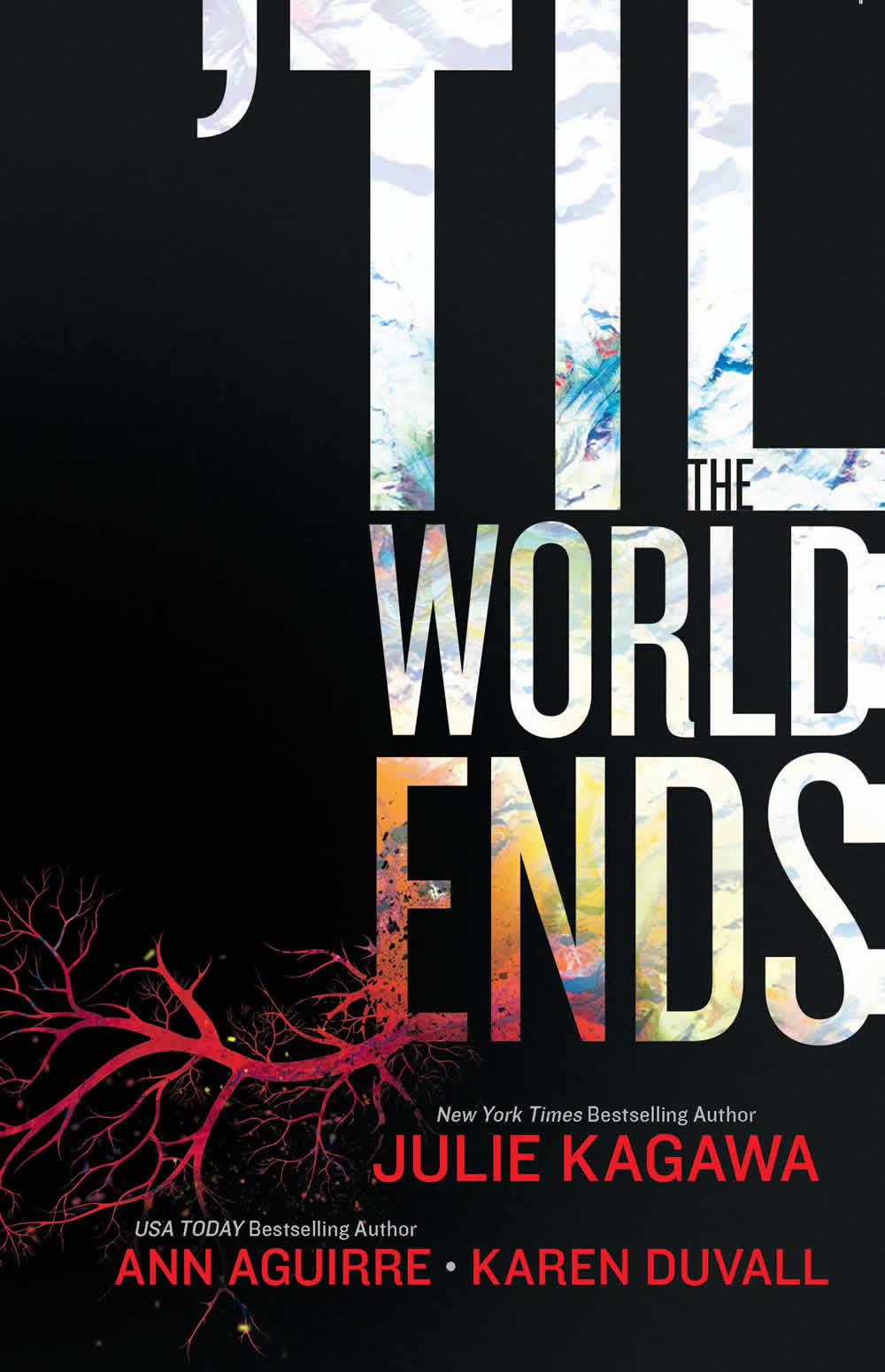
Til the World Ends


Til the World Ends is comprised of three short stories: Dawn of Eden by Julie Kagawa, Thistle and Thorne by Ann Aguirre, and Sun Storm by Karen Duvall. All of the stories are apocalyptic or post-apocalyptic and feature some sort of romance.

In Julie Kagawa's Dawn of Eden, a disease threatens to wipe humans off the face of the planet. Red Lung is widespread and only a small percentage of people survive. After a mysterious man, Ben, and his friend show up at Kylie's clinic, a new symptom appears: bleeding from the eyes. Then the people who died get up again and savagely attack any human around them.  These zombie-vampire hybrids are wild, insanely strong, and bloodthirsty.

The situation basically a zombie apocalypse situation except the zombie aren't around during the day. I liked this story, but it seemed a little run of the mill. The plot was very typical for a zombie situation with one slight difference. The romance is based on instalove (eyeroll) with one sex scene, which was unexpected since it's the prequel to Kagawa's teen series Blood Eden and it did seem a little out of place and out of character for Kylie. I think the characters make pretty stupid decisions and don't stand out much, simply being defined by their attraction to each other. The writing was engaging and really the only reason why I liked this story at all. Overall, it was an ok story with a lame romance and zombie-vampires.

My rating: 3/5 fishmuffins

Thistle and Thorne features a post-apocalytic world ravaged by pollution and chemical spills. The only law of the land is kill or be killed and the mob bosses have taken control of each city, ruling with fear and intimidation. The extremely rich get to live in protected communities, away from the harmful pollution. Everyone else, including Mari Thistle, gets to live in the Red Zone, scavenge for valuables, and protect what is theirs at all costs. Mari takes jobs as needed to provide for her little brother and sister. A heist goes wrong when she tries to steal a figurine from a rich community based on out of date plans. She goes into hiding to escape the mob boss Davros that hired her and teams up with Thorne, who works for the mob boss but is using Mari's situation to plan his downfall. Together, they hope to bring Davros' reign of terror to an end.

I loved this story the most out of all of them. There was a sense of companionship between Mari and Thorne  and the story didn't focus too much on their romance. There is initial attraction and they get to know each other over time, but that's about the extent of it. Other events were much more important. These characters had the most development out of any of the other stories and the world was much more interesting. I found the structure of society fascinating and utterly believable if the pollution levels got that bad. I loved that Mari is tough, but has a soft spot for her siblings and will do anything to protect them. The storytelling was good and the pacing added tension and kept me interested. My only real complaint is that the ending feels too abrupt and I want to know what happens to the characters and that world after the ending. This is the only one I would have liked to see as a full length novel.

My rating: 5/5 fishmuffins

Sun Storm describes a world where sun storms cause radiation and either kill people or give them cool powers. Sarah Daggot has the power to predict the sun storms and chases them to warn the potential victims and to get power from the storms. She meets another Kinetic who can control the weather, but he's on the run from a rogue government agent set on caging and experimenting on Kinetics.

I did not like this story. I love a good sci-fi story, but emphasis on the science part. There was no real explanation for the sun storms or the radiation or anything else for that matter. I would have preferred a straight fantasy story with magic if there was going to be no effort to scientifically explain the extreme climate change. The love story was frustrating. One moment, Sarah doesn't trust the guy and then she does and then she doesn't. Ugh. The changes came out of nowhere and didn't really make sense to me. The developments and revelations were cheesy and unbelievable. The ending was too convenient. The characters didn't develop much and the villains were practically cardboard cutouts. I would not read another story by Karen Duvall.

My rating: 1/5 fishmuffins

Friday, August 31, 2012

Insurgent


** Spoilers ahead for Divergent **

Tris's world is torn apart. Her old faction, Abnegation, is completely shattered and its leaders murdered thanks to the Erudite mind-controlling the entire Dauntless faction into slaughtering them. Dauntless is split into two factions: those against the Erudite and those with them. She and her friends have no place to call home and don't know which faction to turn to, if any. Each faction has to choose a side in this war. The Erudite seem so powerful while Tris's group is just a few ragtag members of Erudite and Dauntless. She also has to work through her own guilt and conflicted feelings in addition to trying to save all the members of her society from being turned into brainwashed automatons. Can Tris and her band of misfits overthrow this powerful and unscrupulous faction? How will their society change in the aftermath of the war?

After I read Divergent, I had to start reading Insurgent right away. Insurgent wasn't as good as Divergent, but it was still a good, enjoyable book. My favorite parts were the development of the factionless, the bad guys, and the well written action scenes. The factionless played a large part of the novel and weren't as destitute and scattered as they seemed in Divergent. They were rather organized and had numbers that rivaled some of the factions. Of course they didn't access to all resources a conventional faction did, but they were armed and ready to join Tris's group against the Erudite. They also made Tris realize that companionship and friendship can exist without factions to hold people together. In this installment, we get a little more insight into the bady guys' point of view, particularly the head of Erudite Jeanine and Peter. Jeanine  was willing to anything in the pursuit of knowledge. Tris's experience in Erudite headquarters showed that even when committing the most heinous crimes against humanity that at it's core, it's a school that studies and learns without emotion. Peter, the sociopath from Dauntless, was shown to have his own code of conduct, not really recognizing right from wrong. He wasn't just out to do evil, but didn't do good just for the sake of being good. The insight into these characters was important to see how the opposite side views themselves.

There were some things I didn't like. Tris was borderline suicidal for much of the novel, which undermined a lot of the development she had in the last book. This took up a lot of pages and could have been cut down. She also constantly lied to Tobias, which was incredibly frustrating. Just tell the truth and try to develop a healthy relationship! I just wanted to shake her. There seemed to be a serum for absolutely everything and Tris was constantly getting injected with something. It got a little old and after a while, it lost its effect on me. My other criticism was that until the end, not a lot really happened. I think this book suffered from second book syndrome and worked to set up the next book without feeling like a complete book on its own.

Although Divergent was much better, Insurgent was an interesting read. The ending was especially earth-shattering and made me overlook many of the flaws. I will definitely be eagerly awaiting the last book.

My rating: 4/5 fishmuffins
~~~~~~~~~~~~~~~~~~~~~
Read as part of Dystopian August at Presenting Lenore.

Wednesday, August 29, 2012

Divergent


Beatrice (AKA Tris) Prior lives in a world ruled by 5 factions: Abnegation, Erudite, Dauntless, Amity, and Candor. Each faction upholds a certain set of virtues in order to keep the peace. Beatrice was born into Abnegation, but has always felt uncomfortable. Slow to act completely selflessly and constantly scolded, she longs for freedom. She has the opportunity to choose a different faction after the aptitude test, which yields inconclusive result and labels her Divergent. Of course she has no idea what this means and, after being urged to keep it hidden, she keeps it secret from everyone. At the Choosing ceremony, she changes factions to Dauntless, who value bravery. The Initiation process is grueling and torturous, but beyond the Dauntless headquarters, conflict and unrest are growing in the rest of the world. Can Tris make a difference in the face of faction turning against faction?

Divergent is one of the most hyped books I have ever heard, so I was reluctant to read it. I have been burned before by books like Hush, Hush, Fallen, and the Nightshade series. Fortunately, Divergent lives up to all the hype and proves itself to be a unique dystopia with likable characters and constant action. Tris is an amazing heroine. She evolves through the story and makes some mistakes. At first, she is timid and typically Abnegation, but doesn't feel like she really fits in. Then she is thrown into this very different Dauntless world, which is the exact opposite of what she has been raised to believe. She has to figure out for herself what about each of her factions she wants to internalize and what she wants to reject. Many people can relate to this because if you choose a different life for yourself than how you were raised, you have to do that same thing. She makes mistakes sometimes and has to temper the attitudes of the two factions in herself. Her romance with Four is cute and doesn't take precedence over the main conflicts. Plus I actually like Four. He has Tris's best interests at heart and is actually quite vulnerable and sweet under all that darkness and mystery.

I love the world Tris lives in because it's believable that our world would try to solve its problems that way. Right now, things like race, sexual orientation, religion, political leanings, gender, and class separate us from each other. Conflicts arise and our society is split because of these issues. In the Divergent world, none of that matters. Factions were created to eradicate qualities that lead people towards evil, like selfishness, cowardice, and ignorance. The concept could have worked, but, as with anything, people take things too far. Factions are considered more important to people than their own families. Instead of focusing on making peace and upholding what their faction was made for, people hate other factions and work to amass more power. Their values are twisted and distorted until they are unrecognizable. For instance, Dauntless is all about bravery, but the leaders cultivated sadism and cruelty in their members that now that undermines that value. The factionless are also a big problem. They are people who either abandoned their factions or didn't make it past initiation. These people are outcasts that do menial jobs that no one else wants to do and are condemned to live outside the cities in poverty. This system is incredibly flawed and many refuse to see it, even when it blows up in their faces.

Divergent is a wonderful dystopia, much different than the majority out there. The characters felt authentic to me and they actually learned and evolved throughout the course of the novel. I am already reading Insurgent because I can't tear myself away from this fantastic story. Highly recommended to dystopian fans.

My rating: 5/5 fishmuffins
~~~~~~~~~~~~~~~~~~~~~
Read as part of Dystopian August at Presenting Lenore.

Monday, August 27, 2012

Birthmarked


In the future where the world is barren, Gaia Stone had just delivered her first baby as a midwife when her parents were taken by the Enclave, the enclosed and privileged city beyond the wall. Three babies from each midwife in each sector are advanced to the Enclave to lead better lives. It's paradise there and something people outside of the wall never see, but must always serve without question. Gaia has no idea why her parents were taken and waits for days after her own interrogation for any answer. After hearing that her parents will be executed soon, Gaia is determined to go beyond the wall to rescue them. What she find beyond the wall will shock her and force her to completely change her world view. In turn, her actions will change the Enclave forever.

Birthmarked is an interesting dystopia that had some twists and turns I didn't expect. I've been reading a lot of dystopias with enclosed, supposedly idyllic series, but this one is different. The imperfect, diseased, and weak people are condemned to live in poverty and serve the Enclave without ever being part of that world. It's hard work to live, but Gaia and her family have always been happy. When Gaia infiltrates the Enclave, she is shocked to see how different it really is from the propaganda films they are shown. People can be arrested and detained for no reason at all. People are publicly executed as an example to the rest of the population. Incest and genetic abnormalities are a problem because the initial population of the Enclave was too small to begin with, revealing the necessity of bringing in new children to expand the gene pool. This practice also ensures that those outside the wall will never rebel because their own children, brothers, and sisters will suffer. The dumbest thing about this dystopia is that the government bars the creation of any hospitals because it encourages the weak. Hospitals would improve and lengthen their lives in general. It just seems like the whole time, these people are just hurting themselves.

I really like the main characters. Gaia is wonderful heroine with a defined sense of herself and what is right. Before going into the Enclave, she believed taking newborns from their mothers was right and helped her society. Her perspective only changes when she discovers the ugly truths behind the Enclave and adjusts accordingly, working towards the greater good. Her first priority is to save mothers and children like her mother taught her since childhood. Leon is much more fleshed out than love interests usually are. He has his own issues growing up inside the wall, but he is still an outcast. Gaia opened his eyes to the horrible things in his society that he was just used to. I like that the romance with him is a small part of the story than in no way overpowers the rest of the novel.

I liked Birthmarked, but the pace was a little uneven. There was a lot of running around, getting captured, escaping, hiding out. It seems like it could have been streamlined a little bit. Other than that, it was a solid dystopia that got under my skin. The story was realistic and I was interested the whole way through. I would definitely pick up the next book in the series. Recommended for dystopian fans no afraid of grittiness.

My rating: 4/5 fishmuffins
~~~~~~~~~~~~~~~~~~~~~
Read as part of Dystopian August at Presenting Lenore.

Thursday, August 23, 2012

Dark Parties


Neva Adams lives under the Protectosphere. The government tells the inhabitants that there is nothing outside of it, that they are lucky to live there, and that they need protection from the outside world. Throughout Neva's life, people have suddenly gone missing and people around her adapt to the change, not acknowledging that a person is really gone. She and her friends decide to protest and show people that the Protectosphere is harmful with the shortages of just about everything from clothes to technology that hasn't been updated since the sphere was created. Their anti-sphere graffiti makes a huge splash and puts them under the scrutiny of the government. It just makes Neva more determined to find proof of all the lies and find out what really happened to the missing people. Will she and her friends escape the authorities and find the information they are after?

Dark Parties has been on my reading radar for a while and I finally picked it up on impulse at the library. It's a quick read and I liked the world for the most part. The Protectosphere, which is the most obvious and lame name ever, supposedly protects the people within from the dangers of the outside world. The government erases parts of their history and people from their society. They choose everyone's careers and allocates them to the most useful sectors, cutting out the arts entirely. To manipulate its citizens, the government purposely makes certain items scarce, such as birth control to encourage pregnancy to expand their numbers. There are all the trappings for a great dystopia are here. What confused me was the lack of new technology and inability to sustain the old technologies. It would improve the inhabitants quality of life and lure them into a false sense of security in addition to allowing the state to successfully spy on the people. Most of their cameras didn't even work and they relied on the presence of them to be intimidating. The lack of basic things like clothes just makes it seem that goods can't be produced almost at all to sustain the people under the dome. Maybe if people were happier and their needs better met, the state wouldn't have to make so many people disappear.

The characters frustrated me for the most part. Neva wasn't the best heroine. She had guts and nerve, but would do the dumbest things. She criticized her best friend for falling for a guy she barely knows and then does exactly the same thing with the same guy! She also seemed to take a lot of things at face value for someone trying to sift out the truth and lies from the world around her. The most annoying thing about her was that she was more concerned about the drama with a boy and her best friend than with the bigger picture where she could possibly die for her rebellion. Her best friend Sanna is a girl that will change herself and her convictions to please a boy. The boy in question, Braydon, is basically a cardboard cut out of a person with red cowboy boots like Ted Mosby from How I Met Your Mother: no character development, no real personality, and no development of any relationship with him. I would have loved this book at least 80% more without this useless, annoying romance and half-assed love triangle/square.

Dark Parties wasn't horrible, but I wouldn't call it good either. The dystopia kept my interest and was my favorite part, even if some if it seemed counterintuitive. The characters were mostly annoying and the romance distracted from the overall plot. I'm not sure if this is a series, but there has to be something exceptionally compelling in the blurb for the sequel to get me to read it.

My rating: 2.5/5 fishmuffins
~~~~~~~~~~~~~~~~~~~~~
Read as part of Dystopian August at Presenting Lenore.

Wednesday, August 22, 2012

Ashfall


Alex Halprin is a typical sulky teenager who bickers with his sister and fights with his mom constantly. He sulks his way into staying home alone for a weekend while his family visits his uncle in a town about 2 hours away. Celebrating his good luck, Alex settles down to play some video games when his room suddenly collapses. He manages to escape safely, but the danger isn't over. The supervolcano under Yellowstone National Park just erupted and the explosion can be heard all over the US. Ash falls for weeks so heavily that the sun is blotted out. Alex's entire world changes. People he has know forever commit horrific acts to survive. Food and clean water are scarce. The air is hard to breathe. After recovering from the initial shock, Alex decides to find his family and make sure they are safe. The journey leads him to many unexpected places and he will experience death, sorrow, hunger, but also love and friendship. His enduring hope is to find his family at the end of it all.

I hadn't heard a lot about Ashfall before I read it. I was expecting a mediocre, typical disaster novel, but I was so incredibly wrong. Ashfall is one of the best books I've read all year. I loved just about everything about it from the eerily realistic situations to the pacing to the tone to the characters. I couldn't put the book down and read it in every spare moment of my day. The thing I most loved about the novel is the realism. There wasn't anything supernatural in the story at all. Everything that happened in the book is well within the realm of possibility. The science of supervolcanoes was very well researched and plausible, although there is a lot simply not known about them. The rapid breakdown of society after the eruption completely makes sense. The necessities of life are scarce and most people seem to try to hoard these items or forcibly take them from others. Few actually try to help each other, which is depressing but realistic. It shows how things like community, trust, and friendship are precious and rare in truly extreme situations. The pacing could have been terrible since Alex's adventures were chaotic and oftentimes rapidly changing. However, from beginning to end, through his travels and his stints staying with various people, I was always engaged and excited to see where Alex would go and what he would encounter next.

The characters are what makes this book so special. Alex is a typical teenage boy. He isn't superhuman or imbued with powers, but uses everything he has plus logic to make the best decisions. Of course he makes mistakes and blunders about a bit, but he learns and changes from an annoying sulky teen to a strong, resourceful man in a very short time. What makes Alex truly exceptional is that he never loses his humanity, his kindness, or his sense of what is right. In a post-apocalyptic world, it's shockingly easy to justify the most of horrific of acts as survival. Darla is my second favorite character as Alex's companion and friend. Alex may be skilled in Tae Kwon Do, but Darla has way more physical strength and mettle due to working on a farm since childhood. With her practical knowledge and strength, she saved Alex many times. I loved their romance. It grew organically through time spent together and developed through mutual support and care. Ashfall could have been an incredibly depressing, soul sucking book, but their sweet relationship and teasing back and forth provided just enough hope and light to counteract some of the heart rending events. I am usually against a lot of romance in non-romance novels as it tends to overpower the plot, but in this case it is essential to the balance of the novel.

Ashfall is an excellent novel, rivaling many books in the post-apocalyptic genre in general. I like that things aren't sugar coated for a teen audience, including the killing of animals for food and the general violence in this world beyond laws. I can't wait for the next book, due out in October. I would highly recommend this to just about anyone.

My rating: 5/5 fishmuffins


~~~~~~~~~~~~~~~~~~~~~
Read as part of Dystopian August at Presenting Lenore.

Tuesday, August 21, 2012

Struck


Mia Price and her family moved to Los Angeles because lightning rarely strikes there. Mia is a lightning addict and has been struck countless times. Red lightning scars cover her body, a mark of each strike. A huge earthquake hits LA, leaving devastation in its wake and thousands of people displaced, injured, traumatized, or dead. Mia is trying to pick up the pieces of her family and make them whole again. Her mother is practically catatonic and her brother is distant. She and her brother go back to school to get rations from the government and they are approached by two different cult-like groups: the Followers of the Prophet and the Seekers. Both want to enlist Mia for their cause and are kind of creepy. The Followers and the Prophet paint themselves as God's chosen ones and claim to know the exact date of the end of the world. The Seekers want to stop the Followers. Mia just wants to be left alone to pick up the pieces of her life, but she gets sucked into the two cults' conflict anyway. Which side will she eventually end up on?

I really like a lot of the concepts in Struck, particularly the warring cult groups, the setting, and the supernatural aspects. Religious fanaticism is one of the scariest things in the world to me. Anyone can interpret religious texts to say whatever they want and manipulate a group of people into doing insane things as a result. The Followers and their blank, serene stares and their all white clothes are just creepy. The Seekers are slightly less creepy, but not by much with their brands, masks, and red cloaks. People in this book and in real life do the most horrible things in the name of religion and it makes me sick. This aspect is by far the most disturbing thing in the novel. I love the setting in Los Angeles. It's one of my favorite cities and I have been to most of the places she talks about, so I can easily envision how it would look all ruined and post-apocalyptic. The supernatural aspects like her affinity for lightning and the powers of the different groups are unique and never really explained. I enjoyed that it was simply a part of this universe and a different kind of power than is typical.

I have a few problems with the novel. First of all, Jeremy is plain creepy. A guy trying to kill you in the night with a knife is a not a cue to ask him on a date. News flash: abusive, dangerous guys are not sexy and never will be sexy. Please stop writing them this way. Mia had a lot of decision making problems throughout the novel that were kind of annoying. I also just felt that there was something missing in the book. It was all pretty straight forward and the ending fell a little flat to me.

Overall, Struck is a fun YA dystopia that brings in elements I haven't seen mixed together like creepy cults, lightning and energy powers, and LA in ruins. I would definitely read what Jennifer Bosworth writes next.

My rating: 3.5/5 fishmuffins
~~~~~~~~~~~~~~~~~~~~~
Read as part of Dystopian August at Presenting Lenore.

Monday, August 20, 2012

Burn Bright


Retra has wanted to escape to Ixion ever since her brother abandoned her to go there. She lives in an oppressive society where she is a Seal, who upholds this society that denies human nature and things like pleasure and freedom. Ixion is the exact opposite of her home, Grave. Teens from everywhere go there to party, imbibe in various intoxicants, and revel in freedom. Retra finally escapes to Ixion, despite the extreme pain of the obedience strip on her leg, only to find that it's much darker and more dangerous than she realized. Her brother is nowhere to be found and she is drawn deeper and deeper into the disorienting and intoxicating parties. The Ripers, the leaders and guardians of Ixion, are mysterious and not as benevolent as they appear. Can Retra keep from getting sucked into this decadent world and escape with her brother?

I went into this book thinking it would be just like all the other young adult dystopian fiction out there. I was pleasantly surprised and completely blown away by the dark world and strange characters. Grave, the awful place Retra grew up in, was oppressive and horrible. There were no freedoms and obedience was obtained through pain and systematic torture. As the story unfolds, more of her past is revealed, going as far as showing that sexual abuse and abuse of power was commonplace with the officials there. Ixion was supposed to be the ultimate experience for teenagers with its constant parties, availability of intoxicants, and encouragement to give into base desires. Underneath all of that, the inhabitants were still kept ignorant of the actual workings of the place, just as in Grave. Retra essentially traded one dystopia for another possibly more dangerous one. Ixion was home to night creatures and Ripers (who I kept calling Rippers in my head, which seemed to be more appropriate). Night creatures were frightening. Any time one of the teens would veer into the darkness, they would be immediately attacked by night creatures, savage and hungry grotesqueries. Their origin proved to be so much more chilling than their attacks. The Ripers make everyone think they are guardians and just want to protect the teens, but they are split into opposing factions: one that wants to continue as it has always been and another that wants to change their ways to pursue more selfish endeavors. I was interested, yet repulsed by both the night creatures and the Rip(p)ers.

The characters were engaging for the most part and served an interesting purpose. Retra wasn't the most charismatic character, but her strength and determination were undeniable. At first, her unease with everything in Ixion kind of got on my nerves, but it was understandable looking at where she came from. She grew on my over the course of the novel because she was willing to stand up to the Ripers and protect her friends when no one else would. It was odd that she changed her name about halfway through the book, but her whole demeanor changed too and it actually made sense with the events of the novel. Suki was a friend that Retra made in Ixion who was from a completely different place where women are warriors and men are subservient, the opposite of Retra's world. She, and other characters, showed how Ixion was the culmination of many different cultures that were completely unaware of each other. I really liked Suki because she was a warrior and stuck by her friends. Lenoir, the head Riper, was a bit like the Darkling from Leigh Bardugo's Shadow and Bone. I went through a lot of the book trying to decide which side of the evil/good spectrum he was on. I liked him even though he gave Retra the runaround a lot when she tried to ask clear questions.

The only part of the book that didn't work for me was the romance (as usual). Retra fell for a random guy on the boat to Ixion and held on to that random crush for the whole novel. I didn't like him and found him to be annoying and unworthy of Retra's affections. The only good thing about him was his ability to play the guitar. Other than this one annoying and lackluster character, Burn Bright was just about perfect. The novel went places I didn't expect and pushed my perception of young adult novels. I can't wait to read the sequel Angel Arias and anything else Marianne de Pierres writes.

My rating: 4.5/5 fishmuffins


~~~~~~~~~~~~~~~~~~~~~
Read as part of Dystopian August at Presenting Lenore.