Thursday, February 13, 2014

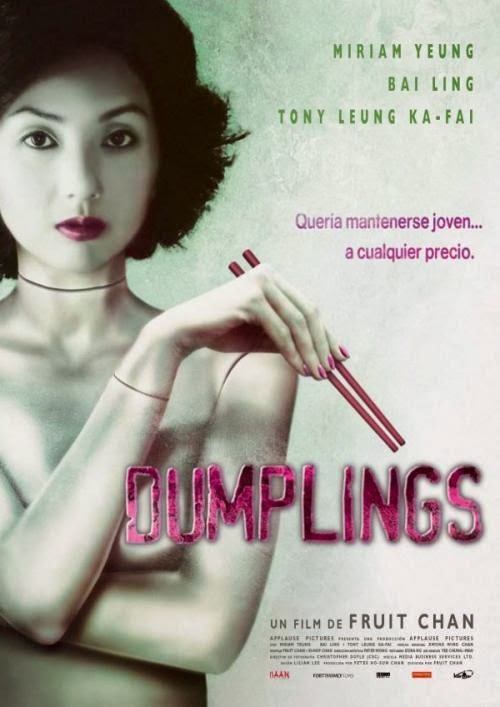
Women in Horror: Dumplings


Former TV star Mrs. Li is unhappy despite her wealth because she feels like she's losing her looks and the interest of her husband. She turns to Aunt Mei, a local chef with several less than legal side businesses, to provide her with dumplings purported to have regenerative powers. The filling of these dumplings are unborn fetuses from an abortion clinic in Shenzhen. Mrs. Li is reluctant and disgusted at first, but soon eats them readily, focusing on the effects rather than where they came from. She demands faster results and Aunt Mei finally locates a five month old fetus perfect for her needs. All seems right with the world after that, but Mrs. Li needs a continual supply of dumplings to stay young. What is she to do when Aunt Mei goes missing?


Dumplings is a disturbing film that focuses on cannibalism, but is actually a biting commentary on society. Mrs. Li is a beautiful woman with no real visible signs of age, but because she is getting older, society views her as an object declining in value. Her husband has lost interest in her and looks to younger lovers to fulfill his needs, opting to throw money at his wife instead of actually spending any time with her. Instead of looking for conventional methods of preserving her youth, she seeks out Aunt Mei and her aborted fetus filled dumplings, an extreme, sickening, and extremely expensive treatment. Mr. Li, on the other hand, has completely grey hair and looks much older than his wife. He is still seen as attractive and has no problems attracting other women despite his awful attitude and blatant objectification of women. He eats balut every day, which is an undeveloped duck fetus, similar to his wife's penchant for eating underdeveloped human fetuses. Both of these people are aging, but society treats them very differently, leading them to view themselves differently as well. Mrs. Li is desperately clinging to her youth through any means possible while Mr. Li is allowed to age and feel secure in himself. This is a commonality with both Chinese and American society.


One of the most disturbing scenes of the film has nothing to do with eating human fetuses. The scene in question is the black market abortion Aunt Mei performs on a young girl named Kate raped by her own father. Aunt Mei makes the procedure much more painful and prolonged in order to keep the 5 month old fetus edible by not using any anesthetic or drugs to induce labor. The fetus is male, which is a rarity because male children are much more desired with the one child law in place. They are more desired, causing many female fetuses to be aborted because of their gender. Since 1990, male births consistently outnumbered female births by more than 10%. The film uses the allegory of eating the fetuses to show the disposable nature of female fetuses in that society. The male fetus took a while to locate and was only available because of its incestuous origins. Kate's situation was tragic, but it seemed as if her mother would have lived with a rapist if the evidence could be gotten rid of. Seeing how rape victims are treated in more egalitarian societies, I'm not surprised that her mother didn't go to the police. Kate's death didn't mean much to anyone in the film except her mother. A couple of men sat in her blood on the bus, but they didn't stop to see if someone needed help. She simply bled to death in the street with only her mother to cry over her, which was the result of being both poor and female.

Class plays a large part in the film as well. Agelessness is something that can't be bought by usual channels, so Mrs. Li has to go into a poor neighborhood to Aunt Mei for her remedy. Aunt Mei is outside of society in a lot of ways. She's over 60 years old, but appears in her thirties, proving to be above society's usual scrutiny about aging women. Although she lives in a poor area and doesn't have a lot of material wealth, Mei is happy and doesn't seem to want for anything. Mrs. Li in contrast is incredibly wealthy, but also very unsatisfied and unhappy with her life. After Aunt Mei falls in love with Mr. Li, she refuses to make her dumplings for Mrs. Li, no matter how much money she offers. Mrs. Li's money does nothing to fix her problems and means nothing to Mei.


Unfortunately, Aunt Mei is an exception in that society. Although abortion is legal and sometimes even required in China, Kate's family can't afford a legal abortion, forcing her to get a black market abortion that ends up killing her. The only way the situation gets any police attention is because her mother stabs her father. The masseuse who Mr. Li impregnates is sexually harassed by him. She accepts Mr. Li's abuse and Mrs. Li's bizarre request to abort her baby for money. She also shows no real emotion for Mr. Li or her fetus. She was merely using the situation to make money, ascend in class, and improve her life while separating her emotions.


Dumplings is an excellent film that looks at the treatment of women and the difference in class in China. The cannibalism and abortion can overpower what the film is actually about because viewers can get so offended by these issues. Bai Ling gives a nuanced, strange performance as enigmatic Aunt Mei. I like that everything isn't neatly tied up at the end and it's definitely up to interpretation. The film is undeniably disturbing, disgusting, and uncomfortable to watch. If you can get past the cannibalism, it's definitely worth a watch.

My rating: 9/10 fishmuffins

Tuesday, February 11, 2014

Women in Horror: We Need to Talk About Kevin


Eva Khatchadourian's life has completely changed since the incident involving her son Kevin at his school. She used to be a successful travel writer and now she took any job that would have her (in this case a clerk in a travel agency). She used to have a family in a large luxurious house, but now lives alone in a small squalid house. The people of her town are largely hostile towards her, splashing her house with red paint and shunning her. Kevin nears eighteen and she regularly visits him in jail despite not having much to talk about. Eva reflects upon her strained relationship with Kevin and recounts her dreary present through detailed letters to her estranged husband Franklin.

Last year, I watched the film We Need to Talk About Kevin and I had to read the book it was based on because the story is so compelling. The novel is set up in a series of letters from Eva to her husband Franklin. The narrative follows Eva's life from her marriage to Franklin to the present while interspersing events in the present among those of the past. Eva goes on a lot of tangents and is fairly long winded, but she details her feelings and experiences beautifully. I enjoyed getting into her head and seeing her thought processes first hand. Her decision to have children was primarily based on wanting to change their routine and she felt it was the next logical step in life. Motherhood doesn't suit her well when Kevin proves to be a horribly loud, fussy baby, an unpleasant child, and a murderous teen. She resented that her body and her life were no longer her own before he was born and didn't feel that special bond to her newborn that so many people talk about. Society views women as maternal and doesn't take into account women not wanting or liking motherhood. I'm sure Eva is not the first mother nor the last to feel this way, but these women are demonized or simply not acknowledged. Failing to meet Franklin's view of an ideal mother ends up exacerbating all of Eva's problems.

A lack of communication permeates Eva's life. After a while of trying to voice opinions about Kevin, Eva simply stays silent. This is largely due to her husband, Franklin, who has this idealized version of a family that he wants his family to fit in. He loves the good old days and longs for a Leave it to Beaver type nuclear family with a subservient and perfect wife and an enthusiastic, perfect son. Obviously, his family doesn't match that, so his solution is to explain away every problem with Kevin, usually referencing that boys will be boys or that Eva is making things up, and undermine Eva at every turn. When more serious things start to happen, tensions increase as Eva sees through Kevin's act and Franklin continues to wallow in denial. When the situation gets so extreme that she can no longer stay silent, Franklin completely rejects her and wants a divorce. Eva doesn't talk to Kevin because of his incredibly abrasive and manipulative personality and the way he mocks everything she cares about. After that Thursday, her only form of real communication is her letters to Franklin, which is futile since he's dead. These letters are the honest and uncensored outpouring of her feelings and thoughts that no one in her life will end up reading.

Kevin is a frustrating character because he can manipulate almost everyone in his life incredibly well. Although he seems to hate Eva, he has a special bond with her. He only shows his true self to her and puts up a fake front for everyone else. Eva never blames how he is on nature or nurture, but it's undeniable that even from a young age, something was wrong. The one time he shows his true colors was on the day he killed his schoolmates in the act itself and how he exploded at his dad, letting him know just how fake and empty their relationship is. By the end of the novel, Kevin sheds his shell of fakery and shows his fear at moving to an adult jail, his positive feelings about her visits, and his confusion over his murderous actions. Eva visits him every week whether or not he acts like he wants it and they are the only constants in each other's lives. At the end of the novel, they make a real connection and no longer lie to each other. For better or worse, they only have each other.

We Need to Talk About Kevin is an intense and emotional novel. Although many would condemn her as a bad mother or a monster, Eva is merely human. She makes mistakes, but always tried to do what she thought was right. Lionel Shriver portrays Eva in a sympathetic light as someone doing the best they can in an adverse situation. She may not have done everything perfectly, but she isn't responsible for Kevin's actions. The novel provides much more insight to her character than the film, but both works are highly recommended.

My rating: 5/5 fishmuffins

Monday, February 10, 2014

Women in Horror: Dead Set


* spoilers *

Zoe's life is in turmoil. Her father just died and her mother dragged her to a big city to start a new life. Unfortunately, their place is small and in a much poorer area than she lived before. Money is tight due to her father's life insurance paperwork being lost or filed wrong. Her mother struggles to find a job and isn't home much, leaving Zoe alone to dwell on the past and escape in her dreams to spend time with her brother Valentine. Coincidentally, something sinister invades her dreams at the same time as she finds a strange record shop with a hidden room featuring souls for sale rather than records. The proprietor isn't interested in money for her father's soul and asks for a lock of hair, then a tooth, then some blood. Her father's soul leads her into Iphigene, a world where souls stagnate and are stuck for eternity. Can Zoe help the souls of Iphigene or are they doomed to stay there forever?

Richard Kadrey writes wonderful dark fantasy novels with a healthy does of horror and I couldn't wait to read his first young adult novel. Dead Set tells the transitive story of Zoe. When we first meet her, she's stuck in many ways. Her mother is struggling to get a job and her father's insurance is in limbo due to misfiled paperwork, so she's stuck financially and with her relationship with her mother. They don't have time to have a real relationship because they only see each other in passing if at all. School passes by in an unmemorable blur. The only two small shining moments are Zoe's biology class with a fun, enthusiastic teacher and a tentative friendship. All of these things are overshadowed by Zoe's father's death. Her entire life stands still and she's close to being overwhelmed by feelings of helplessness, depression, and sadness. Her whole life has been turned upside down and she's lost interest in living and moving forward. Her only solace and voice of reason is Valentine, her brother who visits her in her dreams.

Then Zoe turns self destructive. She finds the record store with her father's soul and barters to see through her father's eyes in the past and then meet him. Consumed with the need to see her father, Zoe ditches school many times, blows off her new friend, and doesn't think about Amut the proprietor's motives or the effects of her behavior. She's so desperate to see her father that she doesn't stop to think about anything else. After stumbling into Iphigene, the city where the dead should be moving on, Zoe finds it dilapidated and broken down. The inhabitants are as stuck as her because of Hecate, the terrible ruler who took away the sun and prevents the souls from moving on. Iphigene is a frightening place in constant darkness, filled with desperate, broken souls, hungry creatures, and refuse.

Iphigene acts as the liminal stage for Zoe and embodies of her mental state. It also allows her find out who she really is, overcome her obstacles, and move forward with her life. She consistently does what she thinks is right, even if it isn't the easiest thing. Her resourcefulness and fighting spirit allow her to be independent and she doesn't wait around for someone else to save her. Her kindness and compassion also guide her and lead her to help those who would otherwise be cast aside. Her decisions lead her to release the sun, defeat Hecate, and restore Iphigene to its former state as a passing point for souls rather than an eternal purgatory. Her trial doesn't come without sacrifice as she was bitten, attacked, and shot in the chest with an arrow along the way, as is typical for rites of passage. She also restores her own life by ensuring her father's and brother's future so she can move on and make her own future. When she returns to the real world, things get back to normal. Her two week disappearance starts a dialog and she's finally honest and open with her mother. Her mother gets a job and the insurance finally goes through. She looks at the world through different eyes, understands her peers better, and stands more confident and self aware.

I love this story. It's a dark, twisted hero's journey with a dash of Egyptian mythology, magic, and horror. Iphigene is a singular place that Kadrey filled with glorious details that set it apart. I was surprised and pleased by how much horror was in the novel. The flying snake creatures and wolves that serve Hecate were particularly disturbing. The journey is exciting and kept me interested throughout. I also like that Dead Set is a complete story in itself, unlike so very many young adult books. I highly recommend Dead Set and all of Kadrey's other works.

My rating: 4/5 fishmuffins

Sunday, February 9, 2014

Women in Horror: Byzantium


Clara and her daughter Eleanor constantly move from place to place, finally ending up in a sleepy coastal town. Noel meets them by chance and allows them to stay in his recently inherited, but dilapidated hotel Byzantium. Clara starts up a brothel in the hotel to get by while Eleanor sullenly writes and mopes. Eleanor befriends Frank, a sickly local boy, and tells him her deepest, darkest secret: that she and Clara are 200 year old vampires on the run from the Brotherhood, the vampire council that has labelled them abominations. As their story circulates the town, all sorts of unwanted attention plagues the two women from both humans and vampires.


Byzantium is a fresh, feminist take on vampires and stands out in the face of an oversaturated genre. The vampire mythology is markedly different than usual. Blood is still their source of sustenance and an invitation is necessary to enter someone's home, but the sun, garlic, and crosses have no adverse effects. Without fangs, they rely on retractable and incredibly sharp nails. Their history is also quite different. Instead of random bands of loner vampires as is typical, this film features the Brotherhood, a glorified boys club of undead, that decide what is and isn't allowed and enforces those rules. The organization is rigidly unchanging, only making a small allowance to allow Clara to live when she joined their ranks. However, she was clearly labeling her as an outsider and an outcast without the same rights and privileges as the rest of the Brotherhood because of her gender. One of those rights denied her is that of creation, which is incredibly ironic. It calls to mind other real life forums of men deciding what women can and can't do involving reproduction. These men are the villains of the film and hunt Clara and Eleanor for being abominations by virtue of their gender and reproductive choices.


Clara and Eleanor are vastly different women trying to maintain their independence. Clara is fiery, sexual, and independent. Throughout history, Clara has been working as a sex worker to support herself and Eleanor. At first, she was forced into prostitution by a man who raped her. The 19th century held no support or agency for such women. Not even the law protected her and she was damned to suffer abuse her entire life and die at a young age. After giving birth to Eleanor, Clara works tirelessly to give her education and opportunities so she won't suffer the same fate. Then she contracts tuberculosis along the way. When all hope seemed to be lost, she stole from her abusers and took immortality for herself, going against the societal expectations of her time. Afterwards, she chose to be a sex worker in part to support her family, but also to help and protect other sex workers so they can work on their own terms without abuse. She takes that role she was forced into as a child and turns it into one of empowerment. When asked by the Brotherhood what she will do with her power, Clara responds "To bring justice to those who prey on the weak and to curb the power of men." Clara chooses to feed upon those abusers and victimizers who more metaphorically feed on the weak and vulnerable.


Eleanor is much more introspective and quiet. Every place they move, she writes their history and then throws the papers to the wind. Very similar to Louis de Pointe du Lac from Interview with the Vampire, she focuses on examining and reliving the past and is a mite overdramatic and whiny. Like Clara, she makes conscious choices about her feeding habits, opting to feed on the extremely old and close to death. Even though she's over 200 years old, she still acts like a teenager and rebels against her mother by telling humans about their story and generally getting them into a lot of trouble. She befriends a fellow surly, depressed teenager named Frank and confides completely and truthfully in him, causing the aforementioned trouble. Eleanor and Clara have been in a stagnant relationship for 200 years with no change in their dynamic despite all the time that has passed. Eleanor is tired of the lies, the prostitution, and acting like a regular human teenager she appears to be. At the end of the film, Clara realizes this and sets Eleanor free with directions to the place of creation so she can journey forward in her life, form her own relationships, and choose how she wants to live.

Byzantium is a feminist film at its core, but makes an effort to differentiate men from the evil patriarchal Brotherhood. Many men are portrayed who are decent human beings. Noel welcomes Eleanor and Clara to live in his abandoned hotel and seems like a sweet person going through grief after his mother died. Frank is an nice if odd young man who makes a real connection with Eleanor. Darvell. although a member of the Brotherhood, defects when he executes the leader instead of Clara as he was charged to. He has a mind of his own and chooses to reject the Brotherhood's policies and mindset.


Byzantium is a fantastic film that portrays feminist ideals with an interesting, nuanced story. Gemma Arterton and Saorise Ronan impressively portray Clara and Eleanor and their complex relationship. Even though obviously frustrated with each other, they still love each other and will fight to protect each other. The portrayal of men is varied instead of the one dimensional one used in most films like this, differentiating between systematic patriarchy and men. This film is well made, beautifully shot, and much different than most in the vampire genre. Highly recommended.

My rating: 8/10 fishmuffins

Saturday, February 8, 2014

Women in Horror: X is for XXL from ABC's of Death

If you'd like to view the film, it's age restricted and only viewable on YouTube here

The ABC's of Death as a whole was pretty disappointing with many silly, pointless, or boring segments. My personal favorite segment was Xavier Gens' X is for XXL. It is the most real because it deals with actual issues affecting people portrayed in a horrifying and grotesque way. The short starts with the woman going home like she would do any other day. Two things stand out. First, passersby and random people loudly and obnoxiously insult her because of her weight. This usually doesn't happen in reality because most people have tact, but the accusing and disapproving stares of judging people (which is much more likely to be the case) can speak volumes. It could also be the woman's own  views about her appearance reflected back at her by the passersby. Her response to the abuse is either to ignore them or say thank you, possibly suggesting she's used to the abuse or that she agrees. Second, the ads of scantily clad and model skinny women are present absolutely everywhere. Again, reality is exaggerated, but the presence of airbrushed, photoshopped, perfect women in the media is everywhere even though those models don't even look like that. The combination of public disapproval and unattainable beauty standards create a culture of self loathing where women's bodies are never good enough. This scene portrays one day of this woman's life, but these things exist every single day and definitely affect people over time.


Then the woman goes home and binge eats, which is indicative of an eating disorder. This woman may not even truly look as she appears in the film. Body dysmorphic disorder often accompanies eating disorders, causing people to believe they appear much different than they actually are. Regardless of what she really looks like, she feels it isn't good enough compared to the ideal paraded in the media. Then, she starts to cut her self with a knife and then finishes cutting herself into the ideal shape with an electric carving knife. Dripping with blood and skinless, she stands for a few seconds and poses in a sick parody of a model before she collapses and presumably dies. Many women, whether they have an eating disorder or not, find themselves doing unhealthy things to lose weight, and appear more as the media and society tells us we should look like. I've heard people say (and even thought to myself), "if only I could just cut the fat away." This short perfectly captures the pressures and mindset many women experience.


While googling for interviews with Xavier Gens, I stumbled onto a ProAna forum (for people with eating disorders to encourage each other to lose weight and share experiences) where someone posted this short and the women posted their thoughts and reactions to it. They were disgusted, shocked, and found it powerful. For a lot of them, it illustrated what it's like to have an eating disorder. Most found the binging scene more disgusting than the self mutilation scene and used it as a deterrent to eating or binging themselves. A couple of them commented on how much better the woman's shape at the end of the short despite what she had to do to get there. Their comments perfectly illustrated the woman's mentality and gave me a new perspective of the film.

My rating: 10/10 fishmuffins

Friday, February 7, 2014

Women in Horror: Contracted


* spoilers *

Samantha's life isn't where she wants it to be. Her relationship with her girlfriend is pretty much over and she's living with her overbearing mother. She goes to a party to forget about her woes and, after copious amounts of alcohol, runs into a guy named BJ, who drugs and rapes her. She wakes up in her bed without memory of being there and feels awful. Over the next few days, it becomes clear that something is really wrong with her and it's not a run of the mill STD.


Contracted an interesting but uneven film that is the source of much debate. I want to start by saying that Samantha was raped. It wasn't a one night stand as it says in the description and it wasn't consensual. She was drunk and then drugged by the rapist on top of her already impaired state. She doesn't remember getting into the car and BJ didn't stop when she explicitly stated to. The fact that this is a debate and the description and tagline for the film mislabels it just shows how misinformed people still are about rape. People cite the most bizarre aspects to prove it isn't rape, as they do in most real life rape cases. For instance, because she says "we should stop" somehow means she gave prior consent even though she has no memory of even getting in the car. It's just maddening how this is even worthy of debate and illustrates the reasons why Samantha and rape victims like her would rather forget about it and move on with their lives than be subject to public scrutiny and blamed for her attack by ignorant people.


Everyone is Samantha's life is pretty much a horrible person. No one truly has her best interests in mind and are blinded by their judgment of her or see only something they want from her. Her girlfriend Nikki is done with her at this point and only sees her as an annoyance. She has no interest in Samantha's life or in anything she cares about. Samantha's mother only sees her as a drug addict (which she was and has since rehabilitated). Everything Samantha says and does is suspect due to her past behavior. In addition, her mom is quite religious and disapproves of her sexual orientation and current relationship. Riley and every other guy that hits on her in the film only see her as their sexual fantasy, not as a real person with her own thoughts and feelings. Her rapist sees her as equivalent to the corpse he raped at the beginning of the film. Her friends only ask about her girlfriend while she's at the party instead of asking her about how she's feeling and if she wants to talk. When she's exhibiting disgusting symptoms, everyone she knows only mentions that she looks like crap. They describe how her appearance affects them rather than being truly concerned about her health. Every single person in Samantha's life is more concerned with themselves and their opinion of her over Samantha as a real person and her well being.


Samantha is the only likeable person in the film even if she does things that are infuriating. Throughout the film, she pretends to be fine and tries to push everything real under the surface to appear normal. It starts with her relationship with Nikki, which is completely falling apart, but she keeps hope to appear confident in the eyes of her friends and her mother. She also suppresses the rape, even going so far as not going to the doctor until something is clearly wrong, because she thinks it will ruin her chances with Nikki. Everything in her life is done for the benefit of those around her instead of for herself. The only thing she truly cares about is her orchids, which look vibrant and beautiful at the beginning of the film. They are her key to independence and open up opportunities to earn money, go to school, and move out on her own. When she awakens from the night she was raped, the orchids are still healthy, but less vibrant. By the end of the film, the flowers are neglected, wither, and die. These flowers reflect Samantha's own decay, which represents how she loses more and more of herself as she lets uncaring people's meaningless opinions define her. By the end, she's literally a zombie, an undead shell.


Contracted is an interesting but flawed film. The pacing is a bit off and a lot of the performances aren't great. However, Najarra Townsend is perfect as Samantha. She garners just enough sympathy while she's doing infuriating things to allow the audience to care what happens to her. The effects are pretty good and definitely make normally beautiful Townsend into an eerie, frightening creature. The ending surprised me. I thought this was just a body horror film and the zombie aspect was a welcome twist. Overall, Contracted is a decent horror film, definitely worth a watch.

My rating: 8/10 fishmuffins

Thursday, February 6, 2014

Women in Horror: The Conjuring


In 1971, Roger, Carolyn, and their daughters move to an old farmhouse in Rhode Island. Everything is fine and dandy on the first day, but the next day brings odd events. Carolyn wakes up with weird bruises and the family dog is found dead outside. The weird happenings increase and Carolyn is attacked in the middle of the night and locked in the cellar. The family contacts paranormal experts Ed and Lorraine Warren,who ascertain that an exorcism might be needed. They need to collect proof to send to the Catholic Church before anything can be done. It looks as if the church won't respond in time to save the family, so the Warrens and the family are on their own to save themselves.


The Conjuring is set in the 70's and a throwback to 70's horror films. It doesn't bring anything new to horror and relies to much on cheap jump scares for my taste. Parts of the film are very atmospheric and scary. My favorite part is where Carolyn is awoken in the middle of the night and lured into the basement by disembodied clapping only to be attacked. The scene was used as an extended trailer and made me excited to watch the film. Unfortunately, it turned out to be the only part of the film I really liked. The film was quite predictable and wasn't surprising in any positive way.


The film was surprising in a number of negative ways. First of all, the writers of the film, Chad and Carey Hayes, wrote this film as religious propaganda and it definitely shows. Faith is brought up in extremely obvious dialog multiple times and the entire film just boils down to a very simple good vs. evil story where faith triumphs over evil. The treatment of women is painfully apparent that the lens of the film is one of conservatism and religion. The evil spirit only directly attacks women. Women have been known in the Bible to be weaker then men and more susceptible to evil, causing original sin and things of that nature. On the night the evil starts, Carolyn initiates sex with her husband and we all know how well the Bible treats seductresses. This act basically ushers the evil in to her and of course the husband is merely an innocent bystander in the situation. Watching the misogyny on the screen was infuriating.


The villain of the film is Bathsheba, an evil witch who sacrifices children to Satan. Even after her death, she has been possessing women and manipulating them into killing their children and/or themselves. It's fun to look at the biblical Bathsheba. King David spied her in her bath, fell in love with her, and seduced her. Then he tried to cover up his sin by ordering the death of her husband. I find it particularly ironic that this evil, child-murdering female is named after a woman who was objectified and victimized by a powerful man and probably raped.

The last offensive thing about the film is the treatment of the Salem witch trials. The film puts forth that real witches were killed for the greater good. Not one little comment was made to say that innocent people died at all. Bathsheba could have committed suicide to save herself from a much more agonizing death being burned at the stake. I understand making history fit a story, but justifying the deaths of innocent people is pretty disgusting.


The Conjuring is a misogynistic and offensive film. Even without reading anything into the story, it's merely derivative of so many other things out there and doesn't do anything new or interesting. I don't understand why so many people seem to love this flat propagandist film.

My rating: 2/10 fishmuffins