Saturday, March 31, 2018
Shiver by Junji Ito
Shiver is a compilation of stories selected by the author complete with sketches, brainstorming notes, and commentary about each story. Some of the stories are brand new while others are from previous compilations or series.
* Used Record
Ogawa plays her best friend Nakayama a record of unaccompanied singing. Nakayama loves it so much, she is compelled to steal it, leading others to pursue her for the haunting melody. This story is absolutely perfect. It's a simple concept that then spirals out of control by the end. Everyone who hears the melody is compelled to take the record. As with any story about compulsion, things get ugly fast. The origin of the melody is completely chilling and comes full circle at the end. There are no wasted frames in this concise, creepy story.
* Shiver
Yuuji lives next door to Rina, a young woman barred from leaving her house due to a mysterious illness. The concept of this story is creepy and taps into a very specific fear that many people seem to have. An affliction that burrows holes in the skin and causes bugs to crawl through those holes is very creepy. The art is amazing and incredibly detailed, especially with those disgusting holes. However, the story itself is too convoluted for the length. The jade statue, the doctor, Yuuji's best friend Hideo, and Yuuji's grandfather's death all took a little too long to explain and had me not even remembering some characters or details at all. The impression of the horror aspects are good, but the story as a whole disappoints.
* Fashion Model
Iwasaki has a bad premonition before seeing a model, Fuchi, with an unconventional appearance. He becomes convinced she has something to do with his future. Her face becomes more and more monstrous as he dreams about her. When a friend wants to make a movie, she applies for a role and is accepted due to her fame. What will happen when they meet? This story plays into an Ito trope where ugly people are always monstrous, but it is creepy. The detail of the woman's teeth is incredible. Ito knows how to make people look otherworldly at first and then like complete monster. The ending is definitely memorable. It's kind of like a Tales from the Crypt story, showing how typecasting based on appearance might not go so well. The plot is pretty clear cut and predictable, but I hoped it wouldn't be true. This gave the story some nice suspense to see if Iwasaki (and I) was right.
* Hanging Blimp
Terumi Fujino, idol and TV personality, hanged herself. Later, people claimed to see her head over the trees at night. It later becomes clear it's not a hallucination and soon the entire sky is populated with giganyic blimps of people's faces with nooses attached that try to kill their human counterparts. This story is my favorite of the bunch. The beginning is a bit of mystery and then the surreal horror completely takes over. All of Tokyo is affected by this and makes even leaving the house impossible. How is anyone supposed to survive this? People try lots of things. Destroying the blimps makes the human counterpart die in the same fashion. Going about daily life is no longer an option. Most are stuck inside, slowly starving. This is a completely different dystopia than I've ever seen and it's a crazy ride.
* Marionette Mansion
A family works as poor travelling performers when Haruhiko and Yukihiko were young. Yukihiko runs away when their father fell ill. The two brothers reunite seven years later when they happen to live in the same town. Yukihiko's house is bizarre. He and his whole family are suspended by piano wire, operated as puppets by unseen puppeteers. This bizarre tale takes the trope of creepy puppets and pushes it to the extreme. People as puppets are even creepier to me because their muscles atrophy and literally can no longer do things for themselves. The source of the puppet obsession was unexpected and the ending is perfect. This one is memorable and got under my skin.
* Painter
Mitsuo Mori loves to paint specific muses he becomes obsessed with (and sleeps with). His current music is Nana Horie, a beautiful but vapid woman. He meets Tomie, a beautiful women unsatisfied with his paints of her, and finds her infuriating. He descends into obsession over capturing her true charm. I love this story and I consider Tomie to be his absolute best work. The thing I love most is exploitative, abusive men being treated as they treat others. Mitsuo exploits women, sleeping with them and painting them until they bore him and he throws them away for a new one. Tomie exploits him in a similar way, mocking his attempts to capture her. When he kills her, as the men inevitably do, they always die shortly after when she comes back. These stories are so satisfying to read especially in today's political climate.
* The Long Dream
Tetsuro Mukoda is in the hospital due to his dreams getting longer and longer while Mami is there due to her intense fear of death. His doctor is completely baffled and doesn't know how to help him. This one takes something we do literally every day and makes it horrific. For Mukoda, his dreams feel exponentially longer, from a month to a year to a decade and so on. His appearance and physicality starts changing as he seems to age through his dreams. I had no idea where this story would go and it was completely satisfying. The doctor does something awful, but then explains how it's actually helpful and I almost agree with him.
* Honored Ancestors
Risa has lost all her memories after agreeing to marry her boyfriend Mikita. Over time, they get reaquainted, fall in love again, and return to where they were before. Even though everything is going well, there are odd things about Mikita and his family that make Risa anxious. This story also takes something typical and makes it monstrous. This is about familial pressures to marry and have children taking form in disturbing ways. The ending shocked and surprised me with a huge dose of body horror and deep, dark family secrets.
* Greased Oil
Yui and her family live above their barbeque restaurant that gets more and more saturated with grease as time goes on. Both her brother and father start to act bizarrely as the oil index increases. Greased Oil is one of the grossest Ito stories I've read. I always saw frames passed around various internet sites to gross others out. It has extensive body horror and cannibalism. You feel greasy just reading it. I felt so sorry for Yui when her brother is an abusive rage monster and her father loses touch with reality.
* Fashion Model: Cursed Frame
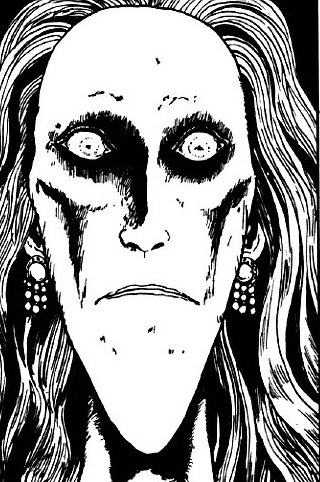
Fuchi returns in a small bonus story. She is featured in the same magazine as a woman deathly afraid of having her body cropped in photos. That woman insults her looks and the inevitable happens. This is more of a mini-story, but it's fun to see more of Fuchi's exploits and how she handles being insulted. I would totally be for a Fashion Model series if he chose to expand it.
My rating: 5/5 fishmuffins
Thursday, March 29, 2018
Noriko's Dinner Table (2005)
Noriko and later her little sister Yuka run away from their small town and quiet lives to Tokyo after talking with other teens online. Noriko leaves first and tries to become her online alias Mitsuko. She meets Uena Station 54, also known as Kumiko, who leads her into a dark world of family roleplay services. Yuka follows into the very same thing, leaving her family broken. Their mother Taeko kills herself and their father Tetsuzo goes to Tokyo to find them.
Noriko's Dinner Table is a prequel/sequel to Suicide Club that I feel would be a stronger film on its own. The Suicide Club element is weirdly shoe horned and doesn't really fit with this group's mission. There are no characters shared between the two films and beyond the train scene being inserted into the film two times, it doesn't share much beyond the question "Are you connected to yourself?" This film is a family drama in its heart. If you come to this film with Suicide Club expectations, you will be disappointed. It has very little violence at all and focuses on each member of the family and their journey.
Noriko leaves her home hoping to find bigger and better things than what her father wants for her. Her demeanor is meek and shy even though she has a fire burning inside her. You would think she finds fame or fortune in Tokyo, but she finds the ability to become whoever she wants. With the family roleplay service, she immerses herself in whatever character she plays, eventually leaving her blank and empty when not acting. Yuka is less able to throw her whole self away, but she also wants something else. She's tired of playing the silly, frivolous little sister and also wants more than small town life. Tetsuzo wants to save his girls and is finally faced with the reality that small towns are not exempt from tragedy. His whole reporter career is based on fluff pieces that try to keep out harsh reality. Taeko unfortunately isn't a fully fleshed out character and seems made to further the polt and create emotional turmoil for Tetsuzo.
The family role play business starts out fairly innocuously. Kumiko doesn't prepare Noriko as they go to a man's apartment dressed in rocker fashions. The man berates them, they threaten to leave, and then have a tearful reunion over dinner. I was expecting much worse and it has the potentional of being very exploitative. Kumiko coaches these young women into completely sloughing off their personalities and sense of self where they would gladly play any role no matter what was required. The most chilling scene of the whole film is when Kumiko follows a friend, who is set to play a hated wife, on a job. Kumiko calmly puts on a soothing song while the friend is beaten and then stabbed to death. When the session is over, the man cheerfully gives her bloodstained money with Kumiko expressing no emotion to the whole event. The whole phenomenon is meant to show how far these women will go to get away from their pain and throw themselves into another role.
Noriko's Dinner Table is an interesting film that doesn't quite fit with Suicide Club. It runs fare too long at nearly three hours and could have easily been cut down an hour at least. Much of the film is character voice overs as they bemoan their lives and repeat the same things over and over in sappy poetic terms. The whole first hour is incredibly dull. The pacing overall is incredibly slow and the plot doesn't truly move forward until over half way through. I love the concepts involved, but the pacing and voiceovers get so old after an hour. It's still worth your time if you find any of this intriguing.
My rating: 2/5 fishmuffins
Tuesday, March 27, 2018
Junji Ito's Dissolving Classroom
* spoilers *
High school student Yuuma Azawa and his little sister Chizuma move to a new city. He is remarkable by all because of his habit of apologizing profusely for seemingly nothing, even going so far as bowing down on the floor. His classmates take it as a joke and waste no time making him the target of harassment and bullying. Chizuma also becomes infamous in the neighborhood for following people around and scaring them with her intense stare. Both have conflicting stories of each other. Yuuma claims Chizuma is disturbed and Chizuma claims Yuuma worships the devil and melts people by apologizing so much.
Much like Tomie, this manga follows Yuuma and Chizuma Azawa as they move around Tokyo, affecting people and oftentimes murdering them as they go. Yuuma appears to be a nice young man that helps his community and has an odd habit. In reality, he worships the devi through his extensive apologies and the effect of the power has some debilitating effects on people that causes them or their brains to melt. Chizuma is his annoying little sister taken to the extreme. She is completely honest with anyone she comes across, much to Yuuma's chagrin, and relishes eating the melted brains. The duality between the two is interesting. He lies constantly but appears normal, attractive, and nice while Chizuma tells the truth and appears as monstrous, but doesn't have any supernatural powers at all.
As with most of Ito's stories, body horror is at the forefront with the power melting and disfiguring people. Each story is a little different and Yuuma's power has greater effects as time goes on. He can melt entire buildings of people eventually and the press catches on to the mysterious "disease" going around Japan wherever they go. His powers venture into other territories like constantly resurrecting his parents to abuse him. Chizuma has some stories only about her, like when she falls in love with another boy. It goes about as well as you might expect from a monstrous girl who eats liquified people and parts. The story where Yuuma compliments young women so much that their faces melt and become disfigured is one of my favorites. It's symbolic for how people can be trapped by abusive relationships when the abuser seems so nice and charming.
Dissolving Classroom is unlike a lot of other of Ito's stories. He has tropes he likes to follow and some of his stories can be a bit predictable as I read more and more of his work. I felt completely surprised by the stories and delighted to uncover whatever depravity he has in store. The ending is spectacular, unexpected, and a little tragic. Some argue that Yuuma is unaware of his power, but I thought there was enough implication that he relishes in the effect of his power. The only tiny problem I had was defining electromagnetism as the cause for melting people. If it was left undefined and magical, I think it would have been better. It was an odd detail since Ito rarely tries to explain the supernatural elements. Other than that, Dissolving Classroom is a fantastically twisted horror manga that's a quick read.
My rating: 4.5/5 fishmuffins
Sunday, March 25, 2018
Uzumaki (2000)
The town of Korouzu seems perfectly normal until Shuichi's father becomes fascinated with spirals. In itself, it's not terrible, but he becomes obsessed with it, mistreating his family and leaving work to look at more spirals. When he dies, the obsession doesn't end with him and spreads to a slew of other people including a reporter fascinating with his story, a slow moving student, and students willing to do anything to get attention. Kirei sees the spiral probelm become bigger and bigger around her until it threatens everything she's known.
Uzumaki is based on the manga by Junji Ito of the same name. This film pales in comparison to its source material, but it's incredibly ambitious in what how it tried to capture the manga's surreal, all encompassing horror. The visual effects in particular manage to replicate so many scenes right out of the manga that are striking and unlike anything I've seen even today in movies. I was shocked that so many of the creepy incidences were included such as students turning into human sized snails, possessed spiral hair hypnotizing classmates and sucking the energy from the owner, and one woman fearing spirals so much she removes all of them from her body. It packs the same chilling punch and surprised me even though I knew what to expect. Spirals are shown everywhere in pottery, noodles, bodies, staircases, and in much more subtle ways like the prevalence of the number 6 in the background and the use of outdated rotary phones.
The stories at Kirei's and Shuichi's high school are some of the best because it captures the high school experience. Before the spiral fever strikes hard, many teens go above and beyond to garner attention of their peers. A teen even accidentally kills themselves trying to show off and others (especially the girl with the parastic spiral hair) see it as worth it and something to admire. The compulsion of the spiral melds with typical high school anxieties about bullying, being popular, and pursuing a significant other. Yamaguchi's story of pursuing Kirei in the most annoying way possible, popping out and surprising her at every turn until she stays yes, is present through most of the film. I like that it's portrayed as invasive, weird, and unwelcome right from the beginning, but it increases in intensity as it goes on. The high school and coming of age elements feel more effective in the film than in the manga.
Unfortunately, this film has quite a few limitations because of the era it was made. In many scenes, a photoshopped spiral is placed that seems so easy to make today. Almost every time I saw it, it brought me out of the film. Many of the effects are decent, but showstopping scenes like Shuichi's father's fate aren't really able to be shown. The ending is a bit underwhelming because it wasn't able to get as large scale as the manga. Some storylines are forgotten, completely robbing any emotional impact of some scenes. For instance, Shuichi's mother's fate would have been much more impactful if anyone actually saw it, but it never happened. Also, Kirei is never affected by the spiral for some reason. It has the flavor of the final girl trope, but there's no real reason for it. I preferred the manga where she managed to escape many times from its influence and gained strength each time. All the characters also felt like over the top caricatures even with the dull attempt to fill in the backstory to Kirei's and Shuchi's relationship.
Uzumaki is a flawed film that still has visually striking and disturbing imagery and captures many surreal moments in the manga. While it's a worthwhile film, I would love to see it remade with today's technology. It would widen the film's scope and make them able to show much more of the crazy spiral manifestations. I am also saddened that this film isn't very well known and isn't in print anymore. It's almost impossible to view without overpaying for the DVD and it isn't streaming anywhere. If you have the opportunity to watch it, I would recommend it.
My rating: 3.5/5 fishmuffins
Friday, March 23, 2018
Jisatsu Circle by Usumaru Furuya
* spoilers *
Saya jumped in front of a train with 53 other girls and miraculously survived without injury. A month afterwards, she feels empty and depressed. Her best friend Kyoko tries to help her, but doesn't know what to do when Saya gains a following just like Mitsuko, the girl who led the suicide club, did before her. It's up to Kyoko to find out what's going on and save her friend before another huge bunch of girls dies.
This manga doesn't follow the story of the film at all. Furuya was given complete freedom to make a different story and most of it is very different except for the basic premise, first shocking train scene, and the names of a couple characters such as Mitsuko and Kuroda. This plot is much more streamlined without all the random storylines of the film. It starts in the present, one month after the mass suicide. Then it jumps around to show how Kyoko and Saya became friends and how the first suicide club came to be as well as the story moving forward.
The story centers on Saya and Kyoko's friendship and how they have grown apart recently. As children, they were close and passed a diary back and forth between them to draw pictures or write things that are hard to say face to face. As time went on, Kyoko was too wrapped up in her first romance while Saya's father was hospitalized. Saya turned to sex work to support her family and started to self harm regularly. Kyoko is filled with guilt as Saya recedes deeper into herself after being bullied and continuing to be expoited. She enlists the help of who she thought was a perverted teacher luring her to his apartment. He actually had real information for her and is the first character portrayed as ugly that hasn't been a villain that I've seen in manga.
I was fascinated by this version of a suicide club. Dessert is only mentioned once as a self harming artist. This supernatural cause melds with the internet rather well and occurs in a cycle. The surviving member of the club becomes the new leader, changing their name to Mitsuko, and amasses a bigger group that seems almost hypnotized by her. The fairly new phenomenon of the internet has spread Mitsuko to a much bigger number of people than she had access to before. This is the way to integrate the internet into a story like this. It was another red herring in the film and seemed to reflect general anxiety about something new. I also particularly enjoyed that girls posted there thanking Mitsuko after they had died. It's a small detail that makes everything so chilling.
Jisatsu Circle is a completely different experience than the film. I found it to be a more successful story without the numerous plot lines. The focus on female friendship also made the ending incredibly beautiful, tragic, and chilling all at the same time. This version has many more answers and also more emotions than its film counterpart. The only problem I really had with it was the large amount of nude pictures and frames of Mitsuko. It has its place in the story, but it's too much. Other than that, Jisatsu Circle exceeded my expectations.
My rating: 4.5/5 fishmuffins
Wednesday, March 21, 2018
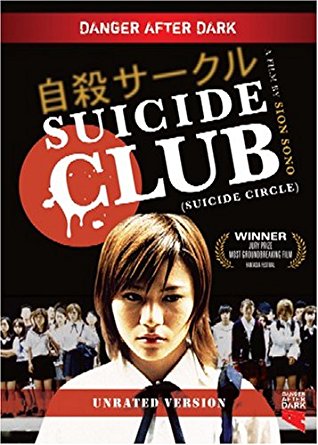
Suicide Club (2002)
Fifty four school girls held hands and jumped in front of a train in Tokyo, drenching everything around with blood and gore and shocking all of Japan. Shortly after, two nurses jump out of a hospital window to their deaths with absolutely no warning. As the amount suicides climb, the police investigate the baffling case. The only clue tying the incidences together is a coil made of strips of human skin, only a few belonging to the dead. What is causing people to kill themselves?
Suicide Club has a shocking, bizarre premise with many different threads making the whole story that occurs over only six days. The police are investigating the suicides headed by Detective Kuroda. Right at the beginning, Kuroda seems like the main protagonist, a seasoned cop working as hard as he can to solve the case. His family is normal with loving moments, bickering, and sullen teens. He doesn't turn out to be the main character. Mitsuko, a young woman almost killed by her boyfriend's suicide fall, plays a much more significant role when she finds clues in her boyfriend's apartment. I love this misdirection because Mitsuko doesn't have expertise and accomplishes more than the entire police force. It also derails the film from its police procedural formula to something else.
The most striking scenes of the film are the suicide scenes. The vast majority of them are done by fairly cheerful people or accompanied by the music of Dessert, a fictional children's pop group. Their music is vapid, cheerful, and people of all ages enjoy it. From the very first blood soaked train scene to a housewife smiling while chopping off her own fingers, these grisly scenes are burned into my brain because of the chilling duality and how each situation varies from the next. Other memorable scenes are obliquely related to the plot such as the glam rock gang headed by Genesis that wants to accept blame for the Suicide Circle. They end up being an odd, musical red herring.
Although Suicide Club is a different film that doesn't follow genre tropes, it's a bit of a mess. The film seems to be pointing to pop music or the internet as sources for the mysterious rash of suicides. However, the ending has more style over substance. There are no real answers which I don't mind, but the bigger questions being asked don't really resonate. It seems to be weird for the sake of being weird rather than connecting to the story. Also, all of the small threads felt more like a series of vignettes in the same world rather than a cohesive story. Overall, Suicide Club is a memorable film that started my love and interest in Japanese horror films. It's definitely dated and has flaws. However, the innovation in plot, misdirections, and cast of characters make me love it still.
My rating: 4/5 fishmuffins
Monday, March 19, 2018
The Kurosagi Corpse Delivery Service Omnibus #1 by Eiji Otsuka and Housui Yamazaki
The Kurosagi Corpse Delivery Service is comprised of five people with special skills. Kuro talks to spirits when he touches corpses. Numata uses a pendulum to dowse for the location of corpses. Makino is one of the few people in Japan that embalms the dead. Yata has a hand puppet that insists he's an alien completely independent of him. Lastly, Ao has a mercenary nature. She makes sure they are paid and figures out unique ways to make money with their talents. Together, they fulfill the wishes of the dead and make a meager living off of it.
The Kurosagi Corpse Delivery Service is an odd manga series and their adventures helping the dead and the living. The most unique thing about this is how it's a horror series that has reverence and respect for the dead. Many of the gut punch moments are emotional in nature, not because of gore or extreme situations. Corpses walk occasionally and it seems to be only if a spirit has an overwhelming need to accomplish something. The author wanted to make the walking dead scary again and does so while maintaining the emotional aspects of the situations. I also very much enjoyed how Buddhism is their main training and faith rather than any Christian religion.
Each story brings something unique that I haven't seen before. The first story is the most extreme with a pedophile, necrophile father and two suicide pact teens. The other stories are less offputting. One of the most emotional ones is when the group finds an elderly woman dead in an abandoned alter. It turns out she put herself there, sacrificing herself so she wouldn't drain the resources her family has. It was tragic and uplifting at the same time, especially with the ending. Other stories I enjoyed involved an elaborate assisted suicide insurance scam (that almost claims the lives of some of the Delivery Service), a melody that influences people into killing themselves with a mundane source, and a funeral home that offers to resurrect murderers for families to kill in revenge. Each story has an element of mystery and an attempt to fulfill the dead's wishes.
Some characters are developed well like Kuro, the main character of the piece, Ao, and Yata. At first, I thought the hand puppet thing was super obnoxious and just there to be weird, but over time, the hand puppets personality is shown to the be completely different from Yata's and actually helpful sometimes. I know the series isn't over yet, but Numata and Makino are useful without much development at all. My only other criticism is the constant inclusion of women either nude or half dressed for no reason at all. When it's just a part of the story, I don't mind. However, when it's completely unnecessary like Ao answering the phone topless or questionable wardrobe choices for only female characters or posters on walls or magazines in the background, it gets annoying and frustrating that this manga is clearly aimed at men by the artist. At least add some sort of detail that makes sense if the artist really wants it there.
The Kurosagi Corpse Delivery Service is a lot of fun despite its flaws. There is a section at the back of each one that translates the sound effects and defines some terms or situations that are culturally unfamiliar to American audiences. The sound effect part is a bit unnecessary and I can find it out by context, but the other definitions and explanations are enlightening. There are 4 omnibuses out right now, each of them containing 3 full length manga. It's a bit unwieldy to read with a 600+ page book, but the unique stories are worth it. I look forward to more character development for all and more Delivery Service adventures.
My rating: 4.5/5 fishmuffins
Subscribe to:
Posts (Atom)